
Hard Enquiries vs. Soft Enquiries on Your Credit File
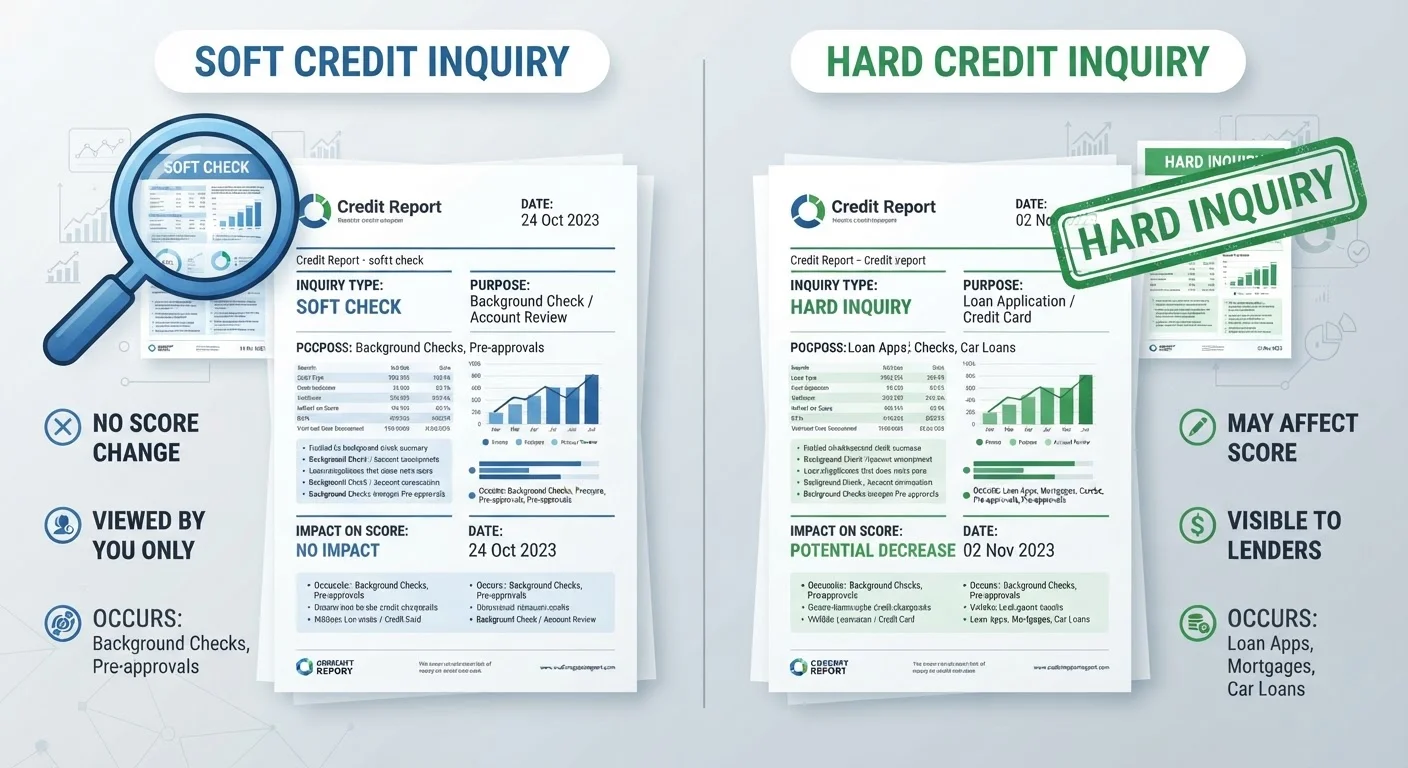
Photo credit: TopInfoTabs.com | Easy Insights For Inspiration
In this article
Clarify what triggers each type of credit check, which one affects your score, and how long the impact typically lasts.
Key Takeaways
- Hard inquiries occur when a lender reviews your credit for a lending decision and can temporarily lower your score.
- Soft inquiries - such as checking your own credit - do not affect your credit score at all.
- Hard inquiries typically remain on your credit report for two years but lose scoring impact after about 12 months.
- Rate shopping for mortgages or auto loans within a short window is usually treated as a single hard inquiry by scoring models.
- Monitoring your credit report regularly helps you spot unauthorized hard inquiries early.
What Triggers Each Type of Credit Check
Every time someone accesses your credit file, it registers as either a hard inquiry or a soft inquiry. The distinction depends on the purpose of the check and whether you've applied for new credit.
Hard inquiries are initiated when you formally apply for a financial product - a mortgage, auto loan, credit card, personal loan, or even some apartment rentals. The lender pulls your full credit report to evaluate your creditworthiness before making a lending decision. Your explicit authorization is required.
Soft inquiries cover a much broader range of situations: checking your own credit score or report, pre-qualification checks that lenders run before extending an offer, background checks by employers (with your permission), and routine account reviews by your existing creditors. These do not require a formal application and in many cases happen without you initiating anything. You can learn more about what these entries look like in your file in our guide to everything on your credit report.
| Hard Inquiry | Soft Inquiry | |
|---|---|---|
| What triggers it | Formal credit application | Self-checks, pre-quals, account reviews |
| Requires your authorization | Yes, always | Not always required |
| Impacts credit score | Yes, typically minor and temporary | No impact whatsoever |
| Visible to lenders | Yes | No - visible only to you |
| Stays on credit report | Up to 2 years | Varies; often not shown |
| Common examples | Mortgage, auto loan, credit card application | Own score check, pre-approval, employer background check |
How Each Type Affects Your Credit Score
The most consequential difference between the two is their effect on your score. Soft inquiries have zero impact - they are visible to you on your credit report but are not factored into any scoring model, including FICO and VantageScore.
Hard inquiries can reduce your score, though the effect is usually modest. According to FICO, a single hard inquiry typically lowers a score by fewer than five points for most consumers. The impact is more pronounced if you have a short credit history or few accounts. For context, credit score ranges and what they signal to lenders are explained in detail in a companion article.
One important exception: rate shopping. If you apply to multiple mortgage or auto lenders within a 14-45 day window (the exact range varies by scoring model), most scoring models consolidate those inquiries into one. This approach lets you compare offers without compounding the score impact. The same protection generally does not apply to credit card applications, so spacing those out is advisable.
Use Pre-Qualification Tools First
Many lenders offer pre-qualification or pre-approval processes that use only a soft inquiry. Taking advantage of these before formally applying lets you gauge your likelihood of approval and compare estimated terms without any scoring impact. Once you're confident in your choice, you can proceed with the formal application - and the hard inquiry it entails.
Hard inquiries affect the "new credit" category of FICO scores, which accounts for roughly 10% of your total score. That context helps put the impact in proportion - it matters, but it's rarely the deciding factor in your overall credit health. Common credit myths often exaggerate how damaging a single hard inquiry really is.
How Long Inquiries Stay on Your Report
Hard inquiries remain on your credit report for two years. However, their influence on your credit score typically fades after about 12 months - and often much sooner. After the two-year mark, they drop off entirely.
Soft inquiries may or may not appear on your credit report depending on the bureau and the type of check. When they do appear, they are visible only to you - lenders and creditors reviewing your file do not see them.
<5 pts
Typical score drop from one hard inquiry
FICO indicates a single hard inquiry lowers most consumers' scores by fewer than five points.
2 years
How long hard inquiries stay on your report
Hard inquiries remain visible on your credit report for two years but lose scoring influence after roughly 12 months.
10%
Weight of 'new credit' in FICO scoring
The 'new credit' category - which includes hard inquiries - makes up approximately 10% of a standard FICO score.
If you spot a hard inquiry you don't recognize, that's worth investigating. Unauthorized hard inquiries can be a sign of identity theft or fraud. You have the right to dispute inaccurate entries with the credit bureaus. Keeping your credit utilization in check alongside a clean inquiry record helps build a stronger overall profile - see our breakdown of credit utilization and how it shapes your score for more on that dimension.
For a full-picture view of how inquiries fit into everything lenders evaluate, the comprehensive guide to debt and credit is a useful next step.
This article is for general informational purposes only and does not constitute personalized financial or credit advice. Consult a qualified financial professional for guidance specific to your situation.

Author
Money & Finance Editorial Team
Money & Finance Editorial Team is the collective byline for our editorial team and contributor network. Articles published under this byline or an editorial pen name are researched, written, and reviewed according to our editorial standards for clarity, consistency, and independence before publication.
View all articles →