
Why Waiting Until You're 'Ready' to Invest Often Costs More Than Starting Early
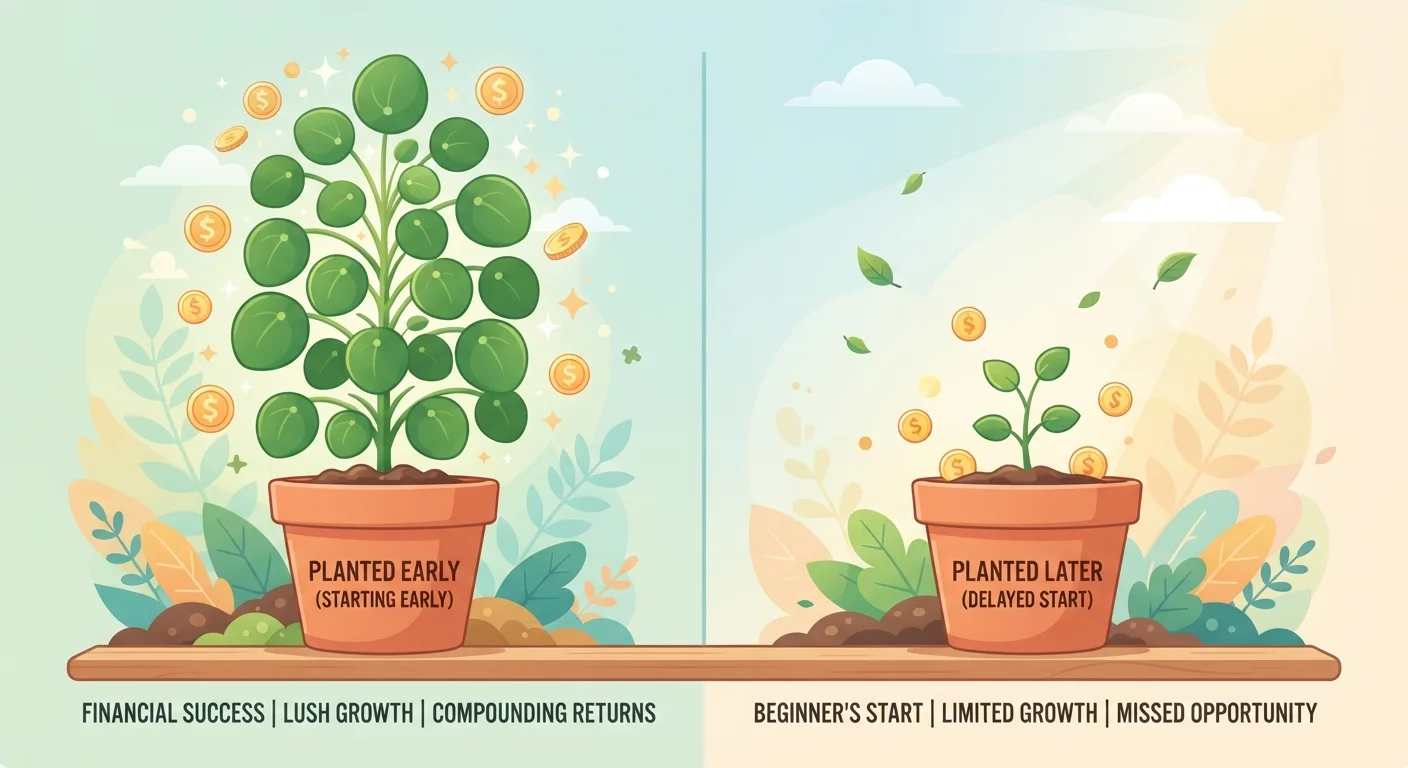
Photo credit: TopInfoTabs.com | Easy Insights For Inspiration
In this article
Explores how compound growth works over time and why small, early contributions can outpace larger, delayed ones — with the math explained simply.
Key Takeaways
- Starting to invest early - even with small amounts - often produces better long-term outcomes than waiting to invest larger sums.
- Compound growth accelerates over time, meaning the first decade of contributions often matters more than the last.
- Waiting for perfect financial circumstances is one of the most common and costly investing misconceptions.
- You do not need a large income or financial expertise to benefit from compound growth.
- Time in the market, not the size of the initial contribution, is the most powerful driver of long-term wealth building.
The Hidden Cost of Waiting
Most people assume that getting their financial house in perfect order before investing is the responsible choice. In practice, that instinct - understandable as it is - can quietly cost tens of thousands of dollars over a lifetime.
The core reason is time. When it comes to investing, time is not just one variable among many; it is arguably the most powerful one. The longer your money remains invested, the more opportunity compound growth has to accelerate. Every year spent waiting is a year that growth cannot occur - and that gap is almost impossible to close later, no matter how large the eventual contribution.
This article is for general informational and educational purposes only. It is not personalized investment advice. For guidance tailored to your situation, consult a qualified financial adviser.
“Compound interest is the eighth wonder of the world. He who understands it, earns it; he who doesn't, pays it.”
— Attributed to Albert Einstein, Widely cited in financial education literature; original attribution is debated by historians
The Math Behind Early Contributions
Consider a straightforward illustration. An investor who contributes $200 per month beginning at age 25 and stops at age 35 - investing for just ten years - may accumulate more by retirement than someone who contributes the same $200 per month from age 35 all the way to age 65, investing for thirty years. This counterintuitive outcome is entirely the product of compound growth: the early investor's gains had decades longer to compound on themselves.
The exact figures depend on assumed rates of return, compounding frequency, account fees, and taxes - none of which can be guaranteed. But the directional logic is consistent across virtually every realistic scenario: early contributions carry disproportionate long-term weight.
10 years
Early investing head start that can outpace 30 years of later contributions
Illustrative compound growth modeling consistently shows that a 10-year early start often yields greater terminal wealth than triple the investing duration begun later, assuming comparable returns.
~$72,000
Potential growth on $100/month invested for 30 years at 7% annual return
At a hypothetical 7% average annual return compounded monthly, $100/month over 30 years would grow to approximately $121,000 - more than triple the $36,000 contributed. Returns are not guaranteed and will vary.
This is why financial educators often describe compound growth as exponential rather than linear. Returns in the final years of a long investment horizon can exceed the returns of all prior years combined - because they compound on a much larger accumulated base.
Why 'Ready' Is a Moving Target
The feeling of not being ready to invest is remarkably common - and remarkably persistent. Research and behavioral finance literature consistently show that people tend to postpone financial decisions until some future condition is met: a raise, a paid-off car, a less stressful month. The problem is that each condition is replaced by a new one. 'Ready' rarely arrives on its own.
Common misconceptions about saving and investing - such as believing you need a high income or a large lump sum to begin - are well-documented barriers that research suggests hold people back far more than their actual financial circumstances do.
Start Small, Start Now
You do not need to wait until you can contribute a significant amount. Setting up even a small automatic monthly contribution - whatever fits your current budget - establishes the habit and puts compound growth to work immediately. You can increase the amount later as your income grows.
If you are genuinely dealing with high-interest debt or have no emergency fund, addressing those first is a reasonable priority. A useful pre-investing checklist is covered in financial moves to make before opening your first investment account. But outside of those specific situations, waiting for a more comfortable moment typically has a measurable cost.
Small Starts Are Not Small Decisions
Beginning with a modest contribution is not a compromise - it is a legitimate and often effective strategy. A $50 or $100 monthly contribution made consistently over decades can grow substantially, precisely because compound growth rewards duration above all else.
If you are new to the basics of how investment accounts work, asset types, and realistic expectations, a comprehensive beginner's guide to investing can help you build a solid foundation. And once you have started, understanding the common missteps new investors make - from reacting to short-term market swings to underestimating fees - can help you stay on course.
The clearest takeaway from compound growth mathematics is not that you should rush or take on risk you cannot handle. It is simply that starting - at whatever modest level your situation allows - is almost always better than not starting. Time cannot be recovered, but it can still be used.
This article is for general informational and educational purposes only and does not constitute personalized financial, investment, tax, or legal advice. Investment involves risk, including the possible loss of principal. Past performance does not guarantee future results. Please consult a qualified financial adviser for guidance tailored to your individual circumstances.
Frequently Asked Questions

Author
Money & Finance Editorial Team
Money & Finance Editorial Team is the collective byline for our editorial team and contributor network. Articles published under this byline or an editorial pen name are researched, written, and reviewed according to our editorial standards for clarity, consistency, and independence before publication.
View all articles →