
Environmental Enrichment for Indoor Pets: Beyond the Toy Basket
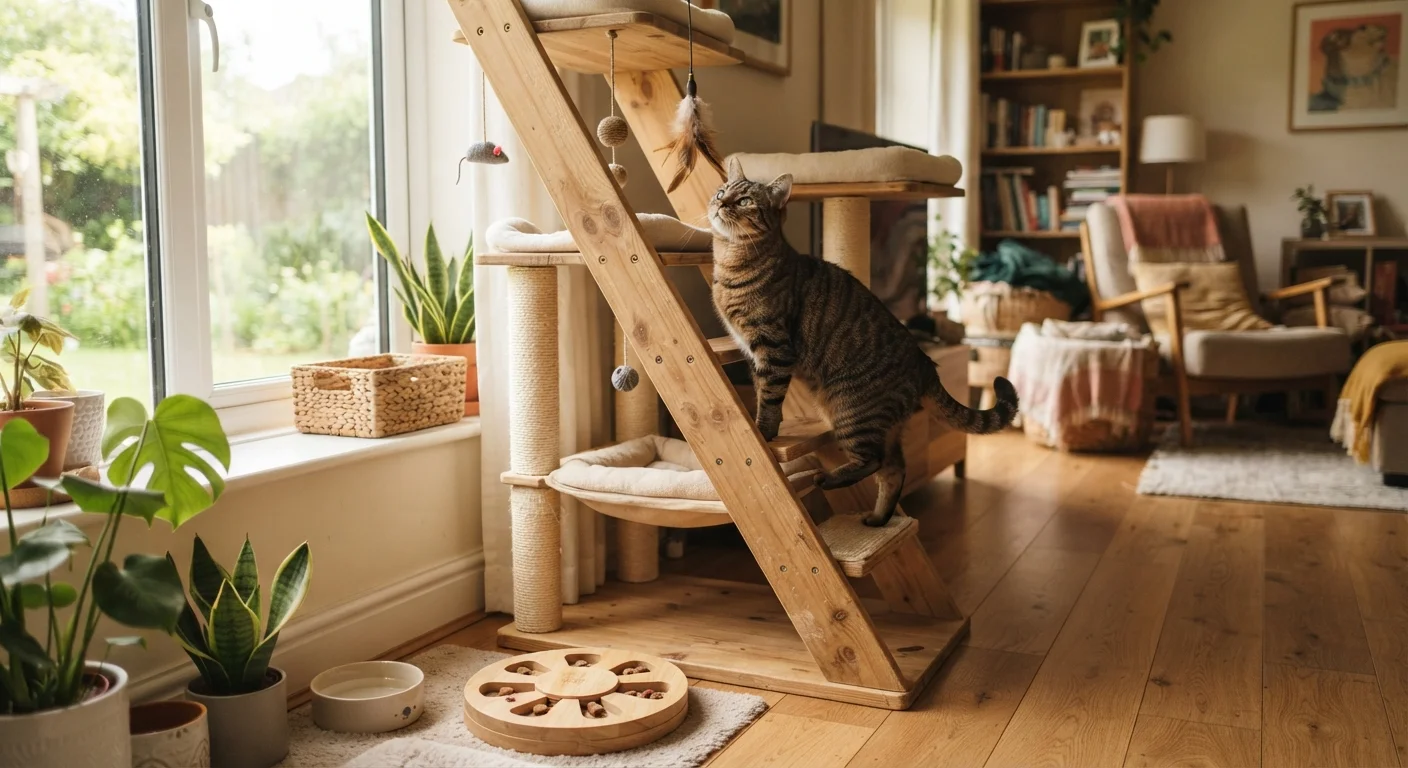
Photo credit: TopInfoTabs.com | Easy Insights For Inspiration
In this article
Mental stimulation is as vital as physical exercise. Explore enrichment strategies that support cognitive health and reduce stress in indoor animals.
Key Takeaways
- Mental stimulation is as essential as physical exercise for indoor pet health and wellbeing.
- Boredom and under-stimulation can manifest as destructive behavior, withdrawal, or repetitive actions.
- Effective enrichment engages species-specific instincts like foraging, climbing, and problem-solving.
- Rotating and varying enrichment activities prevents habituation and sustains engagement.
- Signs of poor mental enrichment often overlap with behavioral and medical issues - consult a vet when in doubt.
Why Enrichment Matters More Than Most Owners Realize
Indoor pets - whether cats, dogs, rabbits, or parrots - live in environments that are physically safe but cognitively thin. Without the sensory variety, unpredictability, and challenges that exist in natural settings, many animals experience chronic under-stimulation. Over time, this can erode emotional wellbeing and, in some cases, trigger measurable physiological stress responses.
The behavioral consequences are easy to misread. A dog who chews furniture may be anxious, not disobedient. A cat who grooms excessively or hides may be bored or distressed rather than simply quirky. If you've noticed shifts like these, our article on recognizing mental distress in pets is worth reading alongside this guide.
Enrichment is the deliberate design of an animal's environment to meet their cognitive, sensory, and behavioral needs. Done well, it supports emotional stability, reduces stress-related behaviors, and strengthens the bond between pet and owner. The strategies below move well past toy baskets into evidence-informed practice.
Foraging and Food-Based Puzzles
In the wild, most animals spend a significant portion of their day searching for food. For indoor pets who receive meals from a bowl in seconds, that entire behavioral drive goes unmet. Puzzle feeders, snuffle mats, and scatter feeding - hiding portions of a meal in different locations - redirect this instinct productively.
Dogs and cats benefit from feeders that require pawing, nosing, or problem-solving to access food. Rabbits and small mammals thrive when hay and leafy greens are tucked inside paper bags or cardboard tubes. Parrots respond well to foraging toys that mimic searching through foliage. The key is matching difficulty to the individual animal - too easy provides no benefit, too hard creates frustration.
Replacing bowl feeding with foraging activities can meaningfully reduce boredom-driven behaviors.
Vertical Space and Three-Dimensional Navigation
Horizontal square footage is not the only dimension that matters. For cats especially, vertical territory - shelves, climbing structures, window perches - is a core psychological need. Elevation provides security, observation points, and opportunities for physical movement that a ground-level environment simply cannot replicate.
Dogs benefit from varied terrain during indoor movement: ramps, low platforms, and textured surfaces engage proprioception (the body's sense of its own position and movement) and provide gentle physical challenge. This is particularly valuable for high-energy breeds confined during inclement weather. For indoor cats, adding window access to watch birds or outdoor movement counts as meaningful sensory enrichment - a point explored further in our look at indoor vs. outdoor cat health trade-offs.
Vertical territory is a core psychological need for cats, not a luxury feature.
Scent Work and Olfactory Stimulation
A dog's nose contains an estimated 300 million olfactory receptors compared to a human's roughly 6 million. For dogs - and to a meaningful degree cats - the nose is their primary interface with the world. Scent-based enrichment engages this capacity in a deeply satisfying way.
Simple nose-work games involve hiding small food rewards in boxes or around a room and letting the animal locate them using smell alone. More structured scent detection training builds on this foundation. Introducing novel scents - dried herbs, safe essential oils in trace quantities, or objects from outdoors - also provides low-effort enrichment. Always verify that any introduced scent is non-toxic for the specific species, as sensitivities vary significantly between dogs, cats, birds, and small mammals.
Scent-based activities tap directly into an animal's primary sense, creating deep cognitive engagement.
Rotating Social and Solo Enrichment
Not all enrichment requires owner involvement, and not all of it should be solo. Both modes serve different psychological functions. Solo enrichment - puzzle feeders, chew items, self-play toys - builds confidence and independence. Interactive enrichment - training sessions, play with the owner, supervised exploration - satisfies social bonding needs and provides unpredictability that self-play cannot.
Short, frequent training sessions are particularly high-value. Teaching new cues or tricks engages working memory, requires focus, and provides a positive emotional experience through reward. Even five minutes of structured training several times a week can have a measurable effect on a pet's behavioral baseline. The Pet Training & Behavior hub offers practical guidance on getting started with humane, reward-based approaches.
Brief daily training sessions deliver both cognitive challenge and meaningful social connection.
Environmental Novelty and Safe Exploration
Novelty is inherently stimulating for most species. Introducing new objects - cardboard boxes, paper bags, safe household items - into a pet's space triggers investigative behavior that exercises curiosity and reduces ambient stress. Rotating these items regularly prevents the environment from becoming static.
Supervised exploration of different rooms, outdoor enclosures, or leash walks through new routes serves a similar function. Even rearranging furniture periodically can provide enough change to prompt re-investigation of a familiar space. For animals prone to anxiety, novelty should be introduced gradually - a large, sudden change can overwhelm rather than enrich. Observe your pet's body language carefully when introducing new elements, and remove anything that consistently causes avoidance or distress.
Rotating novel objects and spaces regularly prevents habituation and sustains genuine curiosity.
Species-Specific Instinct Outlets
Enrichment works best when it targets the specific behavioral repertoire of the animal in question. Cats need to stalk, pounce, and capture - wand toys and moving prey-simulation toys serve this far better than stationary objects. Dogs need to sniff, chew, and carry - structured chew time and retrieve games align with natural tendencies. Rabbits need to dig and burrow - a box filled with safe shredded paper provides a sanctioned outlet. Parrots need to forage, shred, and vocalize - destructible toys made from bird-safe materials address that drive.
When an animal cannot express species-typical behaviors, stress accumulates. This often surfaces as repetitive behaviors - pacing, over-grooming, or feather plucking - that are clinical signs warranting veterinary attention. Enrichment that channels instinct productively is one of the most powerful preventive tools available to owners. For a broader look at daily pet care fundamentals, including physical and emotional health basics, the Pet Care Basics hub provides a useful reference.
Enrichment matched to species-specific instincts is more effective than generalized stimulation.
Building an Enrichment Routine That Lasts
No single enrichment element works indefinitely. Animals habituate quickly to static environments, meaning yesterday's exciting puzzle feeder may be ignored by next week. The most effective approach is one built on rotation, variety, and observation - noticing what engages your pet and adjusting accordingly.
Track What Engages Your Pet
Keep an informal log of which enrichment activities your pet engages with enthusiastically versus ignores. Engagement is usually visible - active investigation, relaxed body language, and willingness to return to an item. If an activity consistently produces avoidance or agitation, discontinue it. This kind of observation also generates useful information to share with your veterinarian if behavioral concerns arise.
For new pet owners establishing these foundations, the first-time owner's health guide offers broader context on integrating mental stimulation into overall care. And if enrichment efforts surface behavioral concerns that don't resolve with environmental changes, common behavioral triggers may help identify what's driving them. When persistent behavioral or physical changes occur, always consult your veterinarian - enrichment supports health but does not replace professional evaluation.
This article is for general informational and educational purposes only. It is not a substitute for professional veterinary advice, diagnosis, or treatment. Always consult a licensed veterinarian regarding your pet's specific health or behavioral needs.

Author
Pets & Animals Editorial Team
Pets & Animals Editorial Team is the collective byline for our editorial team and contributor network. Articles published under this byline or an editorial pen name are researched, written, and reviewed according to our editorial standards for clarity, consistency, and independence before publication.
View all articles →