
Robot Vacuums vs. Traditional Vacuums: Cleaning Performance Side by Side
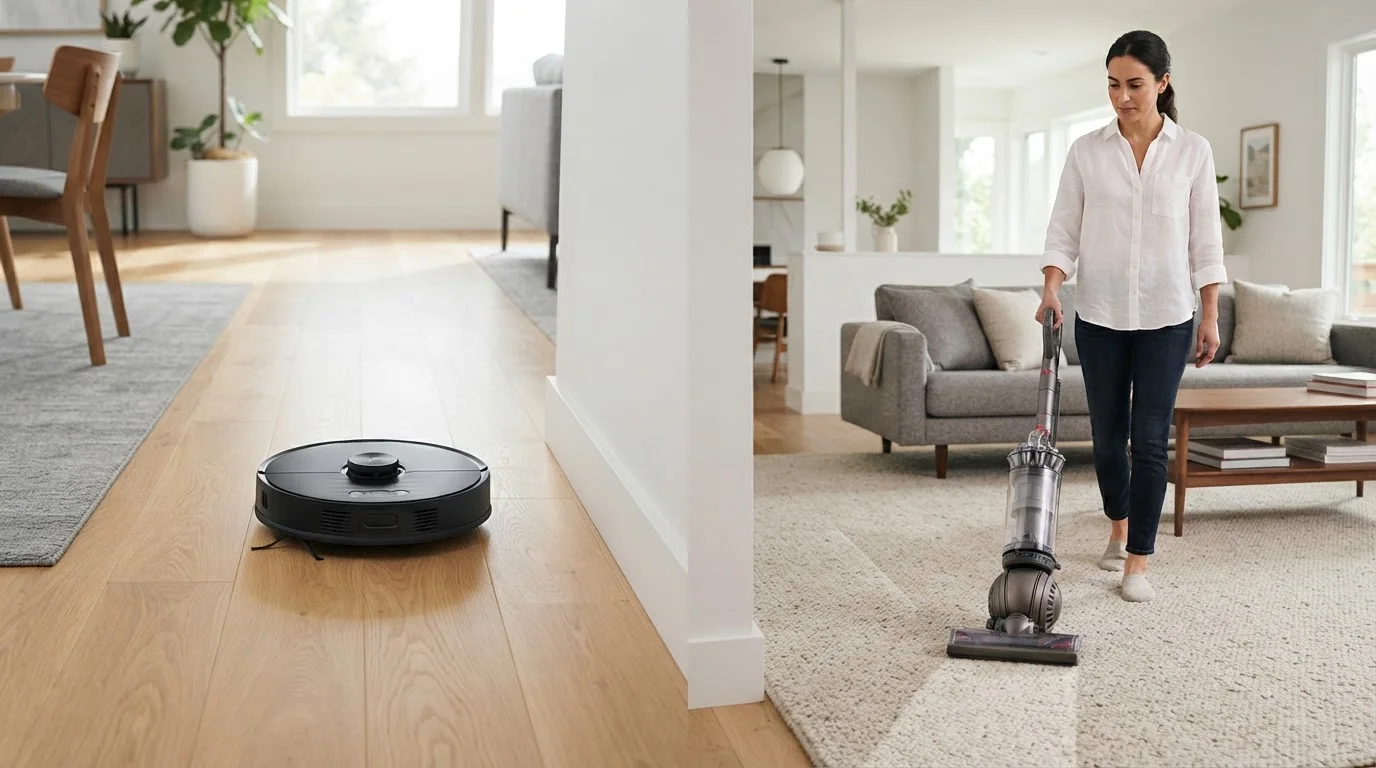
Photo credit: TopInfoTabs.com | Easy Insights For Inspiration
In this article
Robot vacuums are convenient, but traditional vacuums still lead on deep cleaning. See how both handle real-world household messes.
Key Takeaways
- Robot vacuums excel at consistent daily maintenance but rarely match traditional vacuums on deep-cleaning performance.
- Traditional vacuums offer stronger suction and more versatile attachments for tackling a wider range of surfaces and messes.
- Robot vacuums work best as a complement to-not a replacement for-a traditional vacuum in most households.
- Carpet type significantly affects which vacuum type performs better in a given home.
- Robot vacuums require regular bin emptying and maintenance despite being autonomous.
How Each Vacuum Type Approaches Cleaning
Robot vacuums operate autonomously, using onboard sensors, mapping technology, and programmed schedules to navigate floor surfaces and collect debris into a small internal bin. They are designed for frequent, low-intensity passes rather than single deep-cleaning sessions. Most models handle fine dust, crumbs, and light pet hair reasonably well on hard floors and low-pile carpets.
Traditional vacuums-whether upright, canister, or stick models-require a person to guide them but compensate with substantially higher suction power, larger dustbins, and a range of attachments. They are engineered for thoroughness: a single session with a traditional vacuum typically removes more embedded dirt and allergens than several consecutive robot vacuum passes.
The core difference is intent. Robot vacuums maintain cleanliness; traditional vacuums restore it.
| Criterion | Robot Vacuum | Traditional Vacuum |
|---|---|---|
| Suction Power | Moderate; improving but limited | High; suitable for deep cleaning |
| Hard Floor Performance | Excellent; consistent daily results | Very good; manual effort required |
| Carpet Performance | Fair on low pile; poor on thick pile | Excellent across all carpet types |
| Daily Maintenance Effort | None while running; bin/brush upkeep needed | Full manual operation required |
| Stairs & Upholstery | Not capable | Yes, with appropriate attachments |
| Edge & Corner Cleaning | Limited; gaps near baseboards common | Thorough with crevice tools |
| Noise Level | Lower; generally quieter operation | Higher; varies by model |
| Schedule Automation | Yes; app and voice control common | No; fully manual |
Real-World Performance: Where Each Type Wins and Loses
On hard floors-hardwood, tile, laminate-robot vacuums perform impressively. Their low-profile design lets them pass under furniture that a traditional vacuum's head cannot reach, and daily scheduling means debris rarely accumulates. However, robot vacuums struggle near thresholds, around chair legs with wheels, and in areas with cables or small obstacles that can cause them to stall or get stuck.
On carpeting, the gap widens considerably. Traditional vacuums generate suction levels measured in air watts that most robot vacuums simply cannot match. Thick pile carpets, area rugs with fringe, and floors with embedded pet hair consistently favor traditional vacuums. Many robot vacuums will avoid or underperform on high-pile rugs, and their brush rolls can tangle with longer fibers.
~30%
Dirt removed vs. traditional vacuums on carpet
Consumer testing by independent home appliance labs has found robot vacuums typically pick up around 30% less embedded carpet dirt per pass compared to upright vacuums.
2-3x
Frequency robot vacuums need to run to match one manual session
Cleaning performance studies suggest robot vacuums need multiple passes over several days to approximate the debris removal of a single thorough traditional vacuum session on carpet.
Under furniture
Primary area where robot vacuums outperform traditional models
Due to their low-profile design, robot vacuums consistently reach dust and debris under sofas and beds that upright vacuums physically cannot access.
Corners and edges are another weakness for circular robot vacuum designs. Most leave a thin strip of debris along baseboards that a traditional vacuum's edge attachment or crevice tool handles immediately. Some robot vacuums include dedicated edge-cleaning modes, but results vary significantly by model.
Robot vacuums also cannot clean stairs, upholstery, or above-floor surfaces. These tasks remain entirely in traditional vacuum territory.
Maintenance, Setup, and Long-Term Ownership
A common misconception is that robot vacuums are maintenance-free. In practice, their smaller dustbins fill quickly-often requiring emptying after every session in pet-owning households. Brush rolls accumulate hair and debris that must be manually removed to maintain suction. Sensors and charging contacts need periodic cleaning, and filters require regular replacement, just as with traditional vacuums.
Traditional vacuums demand manual operation time but have fewer between-session upkeep requirements. Bagged models in particular can go weeks without attention between uses. Their larger capacity and simpler mechanics tend to mean fewer operational interruptions mid-clean.
Allergy Sufferers: Filter Quality Is Critical
For households managing dust allergies or asthma, the quality of a vacuum's filtration system matters as much as its suction. HEPA filters capture particles as small as 0.3 microns, including common allergens like dust mite debris and pet dander. When evaluating either vacuum type, check whether the filtration is certified and how frequently filters need replacement to maintain effectiveness. This is general information; consult a healthcare professional regarding specific allergy management strategies.
For households with allergies, filtration matters significantly. Many traditional vacuums offer HEPA-rated filtration as a standard or readily available upgrade, trapping fine particulate matter effectively. Robot vacuums increasingly include HEPA or equivalent filters, but their smaller filter surface area means more frequent replacement to maintain performance.
Most cleaning professionals and home maintenance experts suggest treating robot and traditional vacuums as complementary tools rather than direct substitutes. A robot vacuum handling daily light passes, combined with a traditional vacuum used weekly or bi-weekly for a thorough session, typically delivers the cleanest results across a variety of floor types.

Author
Tech & Gadgets Editorial Team
Tech & Gadgets Editorial Team is the collective byline for our editorial team and contributor network. Articles published under this byline or an editorial pen name are researched, written, and reviewed according to our editorial standards for clarity, consistency, and independence before publication.
View all articles →