
Online Reviews: Separating Genuine Feedback from Noise
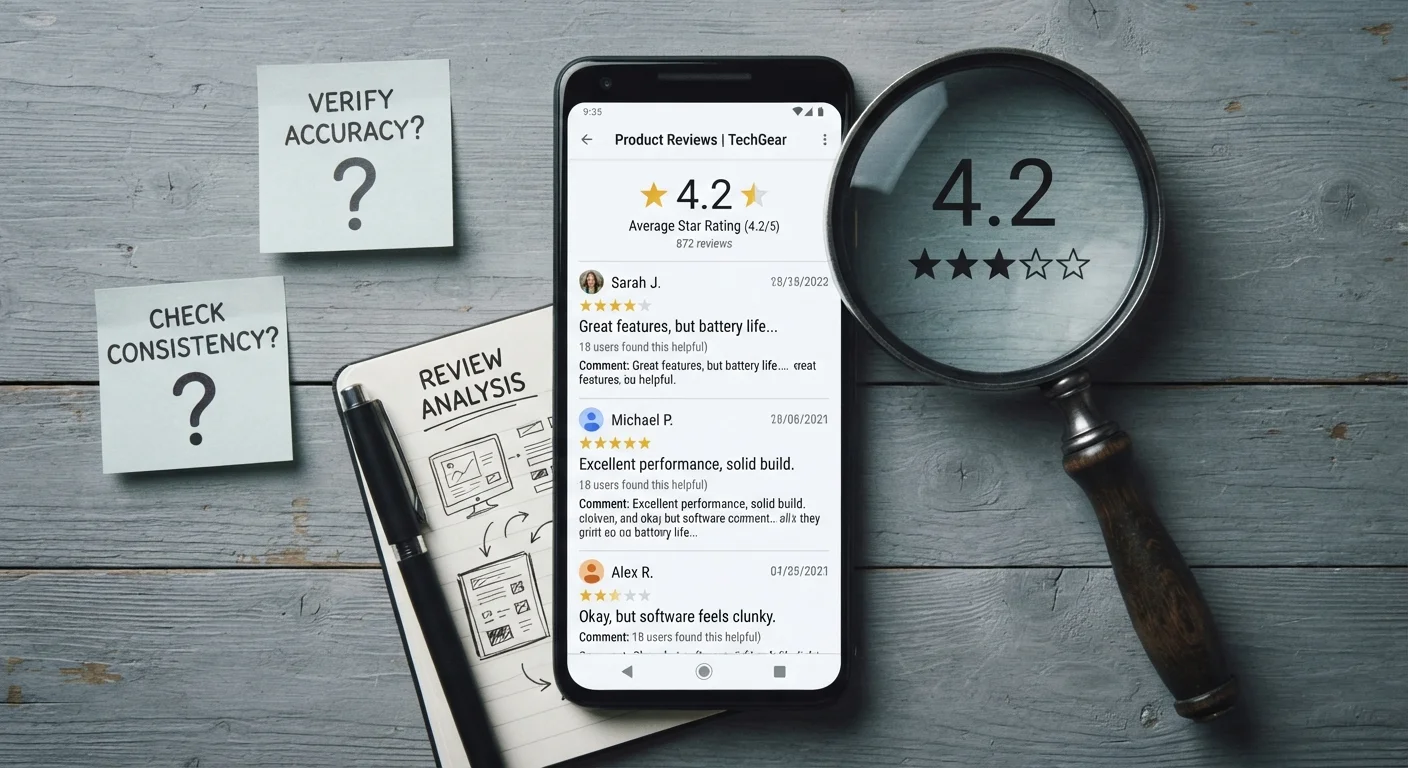
Photo credit: TopInfoTabs.com | Easy Insights For Inspiration
In this article
Not all five-star ratings are earned. Learn how to evaluate review credibility, spot manipulation, and use feedback more effectively.
Key Takeaways
- Review volume and recency matter more than average star rating alone.
- Verified purchase labels, linguistic patterns, and reviewer history help identify fake reviews.
- One- and two-star reviews often contain the most actionable product information.
- Third-party review aggregators can provide a less manipulated cross-platform picture.
- Platforms have commercial incentives that may not align with unbiased review curation.
Why Review Credibility Has Become a Real Problem
Online reviews now function as a primary trust signal for purchasing decisions across virtually every product category. That centrality has made them a target. The Federal Trade Commission has taken enforcement action against companies for paying for fake reviews, and academic research has documented systematic patterns of review manipulation across major retail platforms. The result: a consumer environment where a five-star average is, on its own, not a reliable indicator of product quality.
Understanding how to read reviews critically is not about becoming cynical - it is about applying the same skepticism you would to any other form of marketing. Reviews that look credible on the surface can be the product of coordinated campaigns, incentivized feedback, or algorithmic suppression of negative content. The steps below give you a practical framework for filtering signal from noise.
What you will need
If you find manipulative practices extend beyond reviews into the checkout flow itself, our guide to misleading consumer claims covers the broader landscape of marketing language that often goes unchallenged.
How to Evaluate Reviews Systematically
The steps below take roughly five to ten minutes per product and can meaningfully change which option you ultimately choose. Use the tools listed where appropriate.
Fakespot or ReviewMeta
Browser-based tools that analyze review patterns and flag statistically suspicious clusters on major retail platforms.
Third-party review aggregator (e.g., a platform-independent consumer forum)
Provides cross-platform review data to reduce reliance on a single seller-hosted source.
Check review volume and recency together
A product with 4.8 stars from 11 reviews deserves more skepticism than one with 4.2 stars from 3,000 reviews. Small sample sizes are statistically fragile - a handful of enthusiastic early reviewers can dominate an average. Look at the total count alongside the date distribution. A sudden spike of five-star reviews after a long gap can indicate a review campaign rather than organic satisfaction.
Look for the 'verified purchase' label - but don't stop there
Verified purchase labels confirm a transaction occurred on that platform, which is a useful signal. However, they do not confirm the reviewer used the product as intended, kept it, or wasn't incentivized. Some review manipulation involves actual purchases followed by scripted positive feedback. Treat verification as a floor, not a ceiling, for credibility.
Read the one- and two-star reviews with attention
Low-star reviews are where product weaknesses surface most clearly. Look for specificity: a reviewer describing a zipper that failed after two uses is more informative than a five-star review saying 'love it!' Dismiss reviews that are clearly about shipping logistics if you are evaluating product quality, but cluster recurring complaints about the same defect - those patterns matter.
Examine reviewer profiles for red flags
On platforms that allow it, click through to a reviewer's profile. A history of dozens of five-star reviews for unrelated products posted over a short period is a common marker of coordinated review activity. Conversely, a reviewer with a varied history who has posted both positive and negative reviews across categories is generally more credible.
Cross-reference with off-platform sources
Retailer-hosted reviews exist within a commercial context - the platform has a financial interest in the sale. Search for the product name alongside terms like 'problems,' 'long-term,' or 'after six months' in general web searches and community forums. Independent owners' groups, hobbyist forums, and subreddits often surface durability and reliability issues that never appear in on-platform reviews. You can also use browser extensions like Fakespot to flag algorithmically suspicious review clusters.
For a broader view of how marketplaces use design to influence purchasing decisions, see our guide to dark patterns in online shopping.
Apply your findings to the purchase decision
Synthesize what you have found: Is the pattern of complaints minor and consistent, or does it point to a fundamental design flaw? Does the seller respond to criticism constructively? Are the glowing reviews generic or specific? A product with a 3.9 average driven by substantive, detailed reviews may represent a stronger choice than a 4.7 propped up by a thin and suspiciously uniform review corpus.
Vague praise is a weak signal
Reviews using phrases like 'great product,' 'very happy,' or 'exactly as described' with no supporting detail carry little informational value. The most useful reviews describe specific use cases, duration of ownership, and observed performance. Weight those reviews more heavily regardless of star rating.
Rating averages can be gamed at scale
Some sellers use listing changes - swapping a product's title or main image - to inherit the review history of a previously well-rated item. If a product's reviews mention features or names that don't match what you see in the listing, that is a red flag worth investigating before purchasing.
Platform incentives are not neutral
Retail platforms earn revenue when transactions complete. Their review display logic - what gets surfaced, filtered, or suppressed - reflects that commercial reality. No platform publicly discloses its full review moderation methodology. Treat any single platform's review ecosystem as one data point, not the final word.
Once you have made a purchase decision, the next layer of consumer protection is understanding return terms before you buy. Our explainer on return policies covers what to look for in the fine print.

Author
Smart Shopping Editorial Team
Smart Shopping Editorial Team is the collective byline for our editorial team and contributor network. Articles published under this byline or an editorial pen name are researched, written, and reviewed according to our editorial standards for clarity, consistency, and independence before publication.
View all articles →