
Misleading Claims Consumers Encounter Every Day
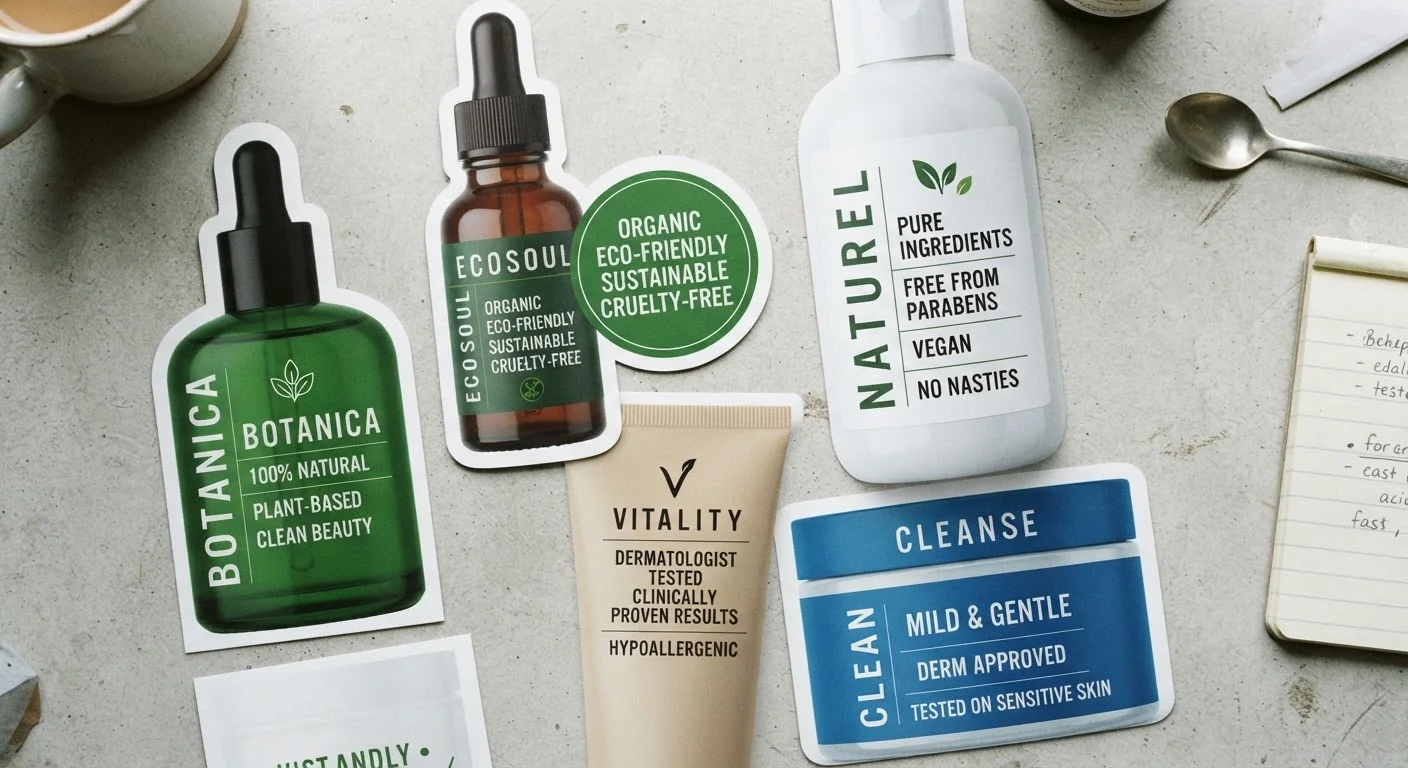
Photo credit: TopInfoTabs.com | Easy Insights For Inspiration
In this article
'Natural', 'eco-friendly', 'clinically tested' — these phrases are common but rarely regulated. Learn what they can and cannot legally mean.
Key Takeaways
- Terms like 'natural' and 'eco-friendly' have no standardized legal definition in the US.
- 'Clinically tested' does not mean a product was proven safe or effective by regulators.
- The FTC and FDA set rules for some claims, but enforcement gaps are significant.
- Third-party certifications vary widely in credibility - the certifying body matters.
- Reading actual ingredient lists and certification documentation beats trusting front-of-pack claims.
Why Label Claims Are So Effective - and So Slippery
Marketing language on consumer products is engineered to trigger trust, not to inform. A term printed in green on a cleaning product or stamped on a supplement bottle feels official - it isn't always. The gap between what a phrase implies and what it legally requires is where most consumer confusion lives.
Several US regulatory bodies have jurisdiction over product claims - the FDA, the FTC, and the USDA, depending on product category - but their authority is fragmented and their definitions are often incomplete or unenforced. Understanding which claims carry enforceable standards and which are essentially decorative marketing copy is one of the most practical skills a shopper can develop.
For a deeper look at how label language plays out on food specifically, see our guide on reading nutrition labels.
Myth
If a product says 'natural,' it means no synthetic ingredients were used.
Fact
The FDA has no formal regulatory definition for 'natural' on most food and personal care products, meaning brands apply the term at their own discretion.
The word "natural" carries enormous marketing weight precisely because it sounds scientific and regulated. For conventional food products, the FDA has stated it has not objected to use of the term when no artificial or synthetic substances are added, but this is informal guidance rather than enforceable law. For personal care products like shampoos and lotions, there is no federal standard at all. A product labeled "natural" can legally contain petrochemical-derived ingredients alongside plant-based ones, depending on how the manufacturer interprets its own policy.
Myth
'Clinically tested' on a product means it was approved or reviewed by a government regulator.
Fact
'Clinically tested' only means the manufacturer conducted or commissioned some form of testing - it says nothing about what was tested, by whom, on how many people, or what the outcome was.
This is one of the most misunderstood phrases in consumer marketing. "Clinically tested" requires no specific study design, no minimum sample size, no independent peer review, and no regulatory submission. A company can conduct a small internal test and technically satisfy the claim. Phrases like "clinically proven" are held to a somewhat higher standard by the FTC, which requires competent and reliable scientific evidence, but the bar is not equivalent to FDA drug approval. Always ask: tested for what, and by whom?
Myth
'Eco-friendly' or 'green' products are held to an official environmental standard.
Fact
There is no single federal certification for 'eco-friendly' in the US. The FTC's Green Guides set voluntary guidance, but they do not function as mandatory law with automatic penalties.
Environmental claims - "eco-friendly," "sustainable," "green," "carbon neutral" - proliferate on packaging without a unified federal standard requiring proof. The FTC's Green Guides advise marketers to avoid vague, unqualified claims and to substantiate specific ones, but a company that ignores this guidance faces action only if the FTC investigates and pursues enforcement, which is resource-dependent. Third-party certifications like those from recognized environmental standards bodies carry more weight, provided the certifier is genuinely independent and publicly discloses its methodology.
Myth
'Hypoallergenic' means a product is guaranteed not to cause an allergic reaction.
Fact
'Hypoallergenic' has no legal definition from the FDA for cosmetics or personal care products, meaning it is a marketing term with no standardized threshold or testing requirement.
The FDA attempted to define "hypoallergenic" for cosmetic labeling in the 1970s, but those regulations were struck down in court. Since then, the term has remained undefined in federal law for most consumer product categories. Manufacturers use it to suggest reduced allergy risk, but there is no required pre-market testing or threshold of allergen reduction that must be met. Individuals with known sensitivities should continue to read full ingredient lists regardless of this label claim, and consult a healthcare provider for guidance specific to their situation.
Myth
A product carrying a certification seal has been independently verified by an unbiased third party.
Fact
Certification seals vary enormously in credibility. Some are issued by genuinely independent organizations with rigorous standards; others are self-created or lightly managed programs that charge fees for their mark.
The certification seal on a product is only as reliable as the organization behind it. A credible certification program will publicly publish its standards, conduct independent audits, require renewal, and maintain a transparent list of certified products. By contrast, some seals are created and administered by industry trade groups or by the brand itself, creating an obvious conflict of interest. Before trusting a seal, a few minutes of searching for the certifier's governance structure and published criteria can save considerable frustration. Our article on what quality labels actually signal covers this in more depth.
What the Data Says About Consumer Trust
Consumer belief in front-of-pack claims is not a niche problem. Survey data consistently shows that a significant share of shoppers treat marketing terms as validated facts rather than unverified assertions. That misplaced trust has real purchasing consequences - and occasionally real safety implications.
~42%
Shoppers who trust 'natural' label claims
Multiple consumer attitude surveys have found that a large share of US adults interpret 'natural' on food labels as a meaningful regulated term, despite the absence of a federal definition.
No legal cap
Federal definition for 'eco-friendly' claims
The FTC's Green Guides provide voluntary guidance on environmental marketing but do not set a binding federal standard; enforcement requires individual FTC action.
The FTC's Green Guides, last substantively updated in 2012 and under ongoing review, provide the closest thing to a federal standard for environmental marketing claims, but they are guidelines rather than hard law. Companies can and do push beyond them without immediate penalty. Similarly, the FDA has repeatedly flagged that the word "natural" on food labeling lacks an official regulatory definition, meaning its use is largely self-governed by manufacturers.
For a broader understanding of your rights when marketing crosses into deception, our article on consumer rights every shopper should understand provides a solid foundation.
How to Evaluate Claims More Reliably
The most reliable signal on a product isn't the headline claim - it's the documentation behind it. For environmental claims, look for certifications from recognized third parties such as Energy Star or established organic certification programs, and then verify the certifying body's methodology. For health and beauty products, "dermatologist tested" tells you a dermatologist was involved at some point; it does not tell you the result or sample size.
Self-Certified Seals Can Look Identical to Independent Ones
A professional-looking badge or seal on packaging does not indicate independent oversight. Some brands design and award their own quality or sustainability marks. Before treating any certification as meaningful, verify that the issuing organization exists independently of the brand, publishes its standards, and conducts audits. If you can't find that information with a brief search, treat the seal as decorative.
A few practical habits help cut through the noise:
- Check the ingredient list against the front claim. A "natural" product with a long list of synthetic preservatives is a mismatch worth questioning.
- Look for the certifier, not just the seal. Some certification marks are self-issued by the brand. Cross-reference using what quality actually means on a label.
- Read the fine print. Asterisks and footnotes frequently qualify bold front claims into near-meaninglessness. Our guide on reading the fine print without a law degree walks through what to look for.
- Treat urgency language with the same skepticism. Phrases designed to pressure quick decisions often accompany misleading product claims. See why 'limited time offer' rarely means what you think for context.
This article is for general consumer education purposes only. It does not constitute legal, medical, or regulatory advice. For questions about specific product safety or labeling compliance, consult a qualified professional or contact the relevant regulatory agency.

Author
Smart Shopping Editorial Team
Smart Shopping Editorial Team is the collective byline for our editorial team and contributor network. Articles published under this byline or an editorial pen name are researched, written, and reviewed according to our editorial standards for clarity, consistency, and independence before publication.
View all articles →