
Why 'Limited Time Offer' Rarely Means What You Think
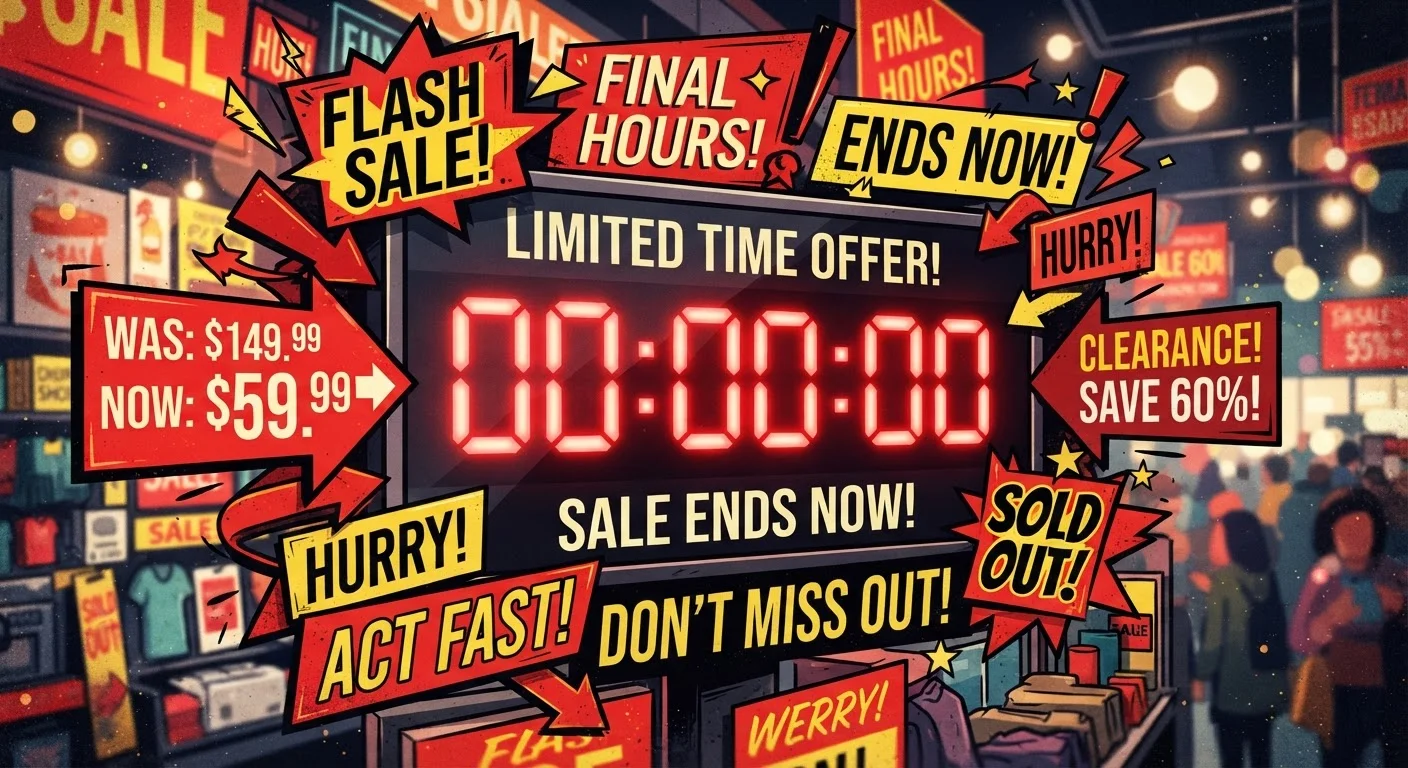
Photo credit: TopInfoTabs.com | Easy Insights For Inspiration
In this article
Urgency messaging is one of retail's oldest tricks. Here's how artificial scarcity and countdown timers manipulate spending decisions.
Key Takeaways
- Most 'limited time' promotions are recurring events dressed up as rare opportunities.
- Countdown timers and low-stock alerts often reflect marketing strategy, not actual inventory.
- A price history check is the fastest way to verify whether a discount is real.
- Urgency messaging exploits a psychological bias called loss aversion to rush purchasing decisions.
- Consumer protection rules require advertised prices to be genuinely available, but enforcement is limited.
The Anatomy of Artificial Urgency
Walk into any online store or scroll through a retailer's email and you'll encounter a familiar arsenal: ticking clocks, "Only 3 left!" banners, and bold red timers counting down to midnight. These elements are not incidental design choices - they are deliberate applications of behavioral psychology, specifically a well-documented cognitive bias called loss aversion. Research in behavioral economics has consistently shown that the prospect of losing an opportunity feels more painful than the prospect of gaining an equivalent benefit. Retailers know this, and urgency messaging is engineered to trigger exactly that discomfort.
What most shoppers do not realize is that many of these time limits are either entirely artificial or endlessly renewable. A sale that "ends Sunday" often simply restarts Monday. A countdown timer may reset the moment it hits zero. This practice is widespread enough that consumer advocates and the Federal Trade Commission have examined how urgency cues intersect with truthful advertising standards.
Urgency Cues and Return Policies Interact
Rushing a purchase because a timer is expiring can mean skipping the step of checking return terms. Some items sold during promotional windows carry stricter return restrictions - marked 'final sale' or subject to restocking fees. Return policies are not all created equal, and urgency-driven purchases are where shoppers are most likely to discover that the hard way.
Understanding the mechanics is the first line of defense. Once you recognize urgency messaging as a structural feature of the shopping environment - not objective information - you can begin to evaluate offers on their actual merits.
Myths vs. Facts: What Urgency Language Actually Means
The following myth-and-fact breakdowns cover the most common urgency claims consumers encounter. Each one is worth pausing on before your next purchase decision.
Myth
If a timer says the sale ends in two hours, the price will definitely go up when it hits zero.
Fact
Many countdown timers are programmed to reset automatically, making the deadline functionally meaningless.
Some retailers use what are colloquially called "evergreen" or "rolling" countdowns - timers that restart at the same interval each session or each day. The timer creates a sense of personal deadline pressure without reflecting any real inventory or pricing event. If you refresh the page or return the next day and the clock has reset, that is a reliable signal the urgency is manufactured.
Myth
'Only 2 left in stock' means the product is nearly sold out and you must act fast.
Fact
Low-stock alerts are frequently triggered by inventory management thresholds, not genuine near-sellout conditions.
Retailers often set their systems to display low-stock warnings once inventory drops below a certain threshold - say, fewer than five or ten units in a particular warehouse. That threshold may have nothing to do with overall supply. The same item may be fully stocked at other locations or in different fulfillment systems. Additionally, some platforms surface these messages as a static feature regardless of real-time stock levels.
Myth
A '50% off' label means you're saving half of what something normally costs.
Fact
Percentage discounts are calculated against a reference price that may be inflated, rarely charged, or no longer current.
The FTC's guidelines on deceptive pricing require that a "regular" or "original" price must have been genuinely offered to the public for a meaningful period before a comparison discount can be advertised. In practice, enforcement is complaint-driven and inconsistent. Some retailers set artificially high "list" prices that almost no consumer ever pays, making a "50% off" badge feel significant when the actual savings relative to the market price is far smaller. A price history tool is the most reliable way to verify what a product typically sells for. See deal-hunting myths that cost people money for more on how percentage framing misleads shoppers.
Myth
Flash sales and one-day events offer prices that are genuinely lower than what you'd find any other time.
Fact
Many flash sale prices match or only marginally undercut prices available on other platforms year-round.
The flash sale format is effective at concentrating attention and compressing decision time - both of which benefit the seller. But comparison shopping across platforms often reveals that the "exclusive" price during a flash event is available elsewhere without a countdown clock attached. Before treating a flash sale as a special opportunity, a quick search for the item's price across multiple retail channels takes under two minutes and frequently surfaces equivalent or lower prices with no urgency attached.
Myth
If you miss a limited-time deal, you won't see that price again for a long time.
Fact
Most promotional prices for mainstream products recur on predictable seasonal or marketing cycles.
Major retail categories - electronics, apparel, home goods - follow fairly consistent promotional calendars tied to holidays, end-of-season inventory cycles, and quarterly earnings pressures. A television discounted during a long-weekend sale will very likely be discounted again within weeks. Treating a missed sale as a permanent loss is a cognitive error that urgency messaging is specifically designed to encourage. Patience is a documented money-saving strategy, not just a platitude.
77%
Shoppers who felt pressured by online urgency cues
A survey by Which?, the UK consumer group, found that a large majority of online shoppers reported feeling rushed by countdown timers or low-stock messages, even when they were uncertain the claims were accurate.
~5x
How often major retailers repeat 'limited' sales annually
Consumer Reports analysis of major retail promotional calendars found that many categories see five or more "sale" events per year, undermining claims of rarity.
How to Verify a Deal Before It 'Expires'
The single most effective counter to artificial urgency is a price history check. Browser extensions and dedicated tracking sites record historical prices at major retailers, letting you see at a glance whether today's "sale" price is genuinely lower than normal or simply the product's everyday going rate. Our guide on reading a price history before you buy walks through the practical steps.
A few additional habits help cut through urgency noise:
- Wait 24-48 hours before acting on any time-sensitive offer. If the deal genuinely expires, assess whether you actually needed the item.
- Search the exact product name plus "coupon" or "promo" - if multiple codes exist publicly, scarcity claims are weakened.
- Check whether the sale recurs on a predictable calendar (holiday weekends, end-of-season) before treating it as a once-in-a-year event.
Urgency framing is just one layer of retail psychology worth understanding. Psychological traps in discount shopping covers related patterns - including decoy pricing and the sunk-cost effect - that interact with urgency cues to erode spending discipline. And if you suspect a retailer's discount claims don't hold up legally, misleading claims consumers encounter every day explains how advertising standards apply in practice.
This article is for general consumer education purposes only and does not constitute legal or financial advice. Advertising regulations vary by jurisdiction; consult a qualified professional or the relevant regulatory body for guidance specific to your situation.

Author
Smart Shopping Editorial Team
Smart Shopping Editorial Team is the collective byline for our editorial team and contributor network. Articles published under this byline or an editorial pen name are researched, written, and reviewed according to our editorial standards for clarity, consistency, and independence before publication.
View all articles →