
Psychological Traps in Discount Shopping - and How to Sidestep Them
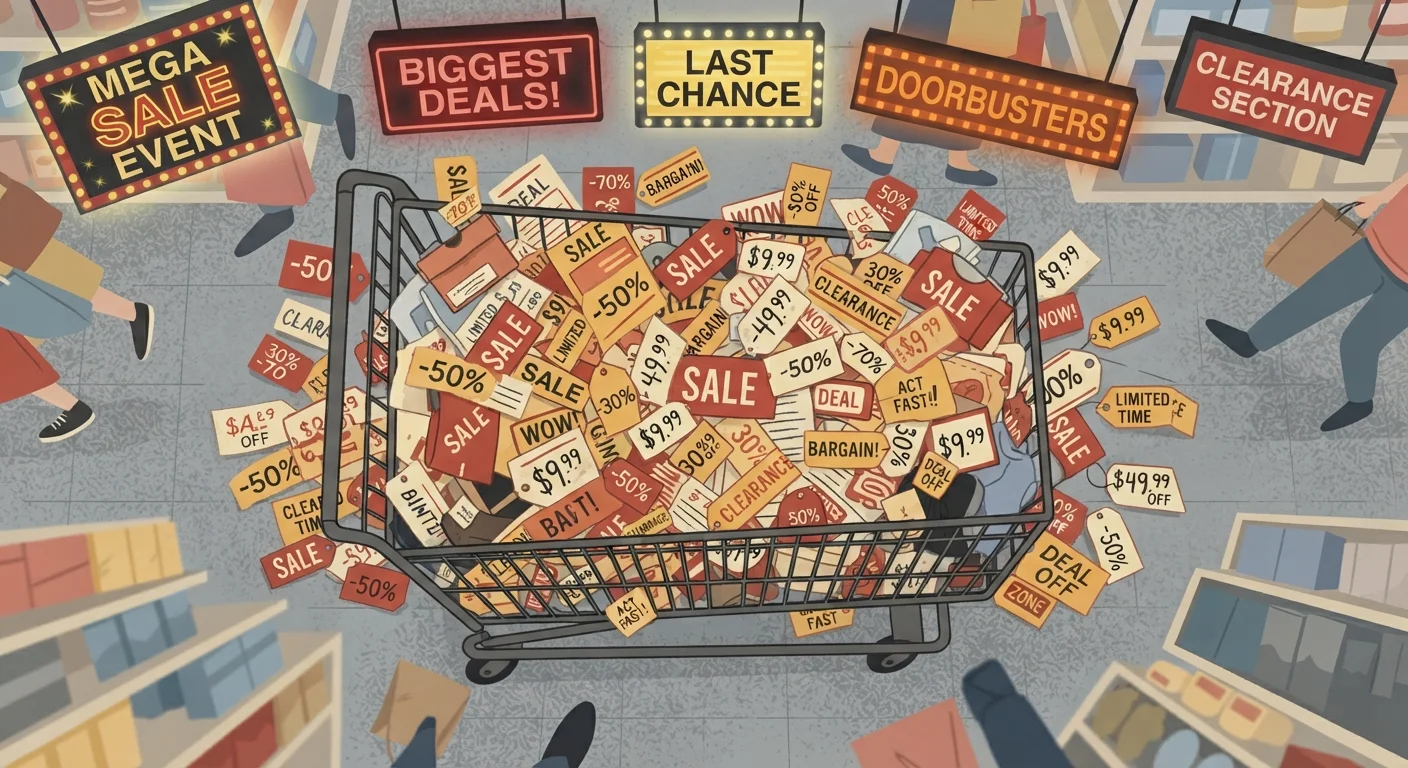
Photo credit: TopInfoTabs.com | Easy Insights For Inspiration
In this article
Sunk cost, decoy pricing, and the thrill of the hunt can push consumers toward poor decisions. Recognising these patterns is half the defence.
Key Takeaways
- Anchor pricing makes inflated 'original' prices feel like automatic savings, even when they aren't.
- The sunk cost fallacy leads shoppers to spend more just to justify what they've already spent.
- Artificial scarcity and urgency messaging are marketing techniques, not neutral information.
- Decoy pricing is engineered to steer you toward a specific option, not offer genuine choice.
- Recognising these patterns before checkout is the most effective consumer defence available.
When 'Saving Money' Becomes a Decision-Making Trap
Discount shopping is supposed to help your budget - but the retail environment is specifically engineered to override careful thinking. Behavioural economics research consistently shows that price framing, artificial urgency, and social comparison can push consumers toward decisions that feel rational in the moment but don't hold up on reflection.
These aren't obscure academic findings. They're the architecture behind most modern retail, both in-store and online. Understanding the specific traps - and what triggers each one - gives you a practical edge the next time a "deal" is competing for your attention. See also our look at dark patterns in online shopping for the design tricks layered on top of these psychological mechanisms.
Anchor Pricing: The Inflated 'Was' Price
Anchor pricing works by presenting a high original price alongside a lower sale price, so your brain uses the first number as a reference point. The problem: "original" prices are not always verifiable, and in some cases are set artificially high specifically to make the discount look impressive. Regulators in several US states have pursued retailers over deceptive reference pricing, but the practice remains widespread.
What to do: Assess the sale price on its own merits. Ask whether you would consider this item worth buying at the current price if no original price were shown. Third-party price-history tools can show whether an item has ever actually sold at the claimed original price.
The 'was' price is a reference point your brain uses automatically - that doesn't make it accurate.
The Sunk Cost Fallacy in a Shopping Cart
Sunk cost thinking shows up in retail in a specific way: once you've invested time hunting a deal, browsed a site for an hour, or driven to a store, you feel compelled to buy something to justify the effort. Retailers understand this - it's part of why loyalty programme points, long checkout flows, and accumulated carts are designed to create a sense of investment before you've spent a dollar.
What to do: Treat time already spent as gone regardless of what you buy. The relevant question is always forward-looking: does this purchase make sense right now, on its own terms? If the answer is no, the sunk cost doesn't change that. Our piece on impulse buying's hidden costs explores how emotional momentum drives unplanned purchases.
Time spent hunting a deal doesn't obligate you to make a purchase to justify it.
Decoy Pricing: The Option That Exists to Steer You
Decoy pricing - also called the asymmetric dominance effect - places a clearly inferior third option in a lineup to make the retailer's preferred choice look like obvious value. A common example: a small item at $8, a large at $14, and a medium at $12.50 that offers slightly more than the small but far less per unit than the large. The medium exists to make the large look rational by comparison.
What to do: Evaluate each option against your actual need, not against the other options in the set. Ask: how much of this will I use? Would I buy the larger option at $14 if the medium weren't there? The answer is often no.
The 'middle' option in a three-tier pricing lineup is often there to make one option look like common sense.
The 'Thrill of the Hunt' and Dopamine-Driven Shopping
Research in consumer psychology suggests that the anticipation of a deal can trigger reward-system activity similar to other forms of seeking behaviour. This means the pleasure can come from the search itself - not from the item's usefulness. Shoppers in this state tend to over-weight the excitement of the find and under-weight whether they actually need what they're buying.
What to do: Notice if your enthusiasm for a purchase is mainly about the deal structure rather than the item itself. A useful test: if this item were full price only, would you still want it? If not, the "deal" is doing the emotional work, not the product. See our broader look at consumer awareness principles for context.
Excitement about finding a bargain and actually needing the item are two separate things.
Bundling and 'Spend More to Save More' Mechanics
"Spend $75 to get free shipping." "Buy 3, get 1 free." These structures are designed to increase total spend by making additional purchases feel like they cost nothing - or even generate value. The math often doesn't support it: adding items you don't need to reach a threshold still costs money, it just comes with a psychological reframe.
What to do: Calculate what you're actually spending, not what you're "saving." If reaching a threshold requires adding items, price those items honestly. Our article on deal-hunting myths that cost people money covers the "bulk always saves" assumption in more depth. Also worth reviewing: how stacking discounts can backfire.
Spending more to unlock a threshold reward still means spending more - frame it honestly.
Social Proof and 'X People Are Viewing This Right Now'
Online retailers frequently display social proof signals - popularity indicators, viewer counts, or low-stock warnings - that create competitive pressure. Some of these figures are dynamic and real; others are marketing estimates or static displays. Either way, they activate loss aversion: the fear of missing out tends to outweigh rational assessment of whether the item is actually suitable.
What to do: Treat urgency signals as marketing, not neutral data. If an item is genuinely right for you, it will still be right for you after a 24-hour wait. A deliberate pause before purchasing is one of the simplest and most reliable filters available to consumers. For more on urgency mechanics, see how urgency messaging is constructed.
Urgency signals prompt competitive instincts - pause and assess whether the item is actually right for you.
Building a Habit of Deliberate Decisions
None of these traps requires unusual sophistication to sidestep - they mainly require a pause. The window between impulse and action is where consumer awareness lives. A practical rule: if a deal creates a sense of urgency, treat that urgency itself as a signal to slow down, not speed up. Our article on why "limited time offer" rarely means what you think breaks down how artificial scarcity actually works in practice.
The 24-Hour Rule Still Works
Adding an item to a wish list or cart and revisiting it the next day is one of the most effective consumer habits available - not because deals disappear, but because enthusiasm reliably does. If the item still makes sense after sleeping on it, the decision is more likely to be deliberate. If it doesn't, you've avoided a spend without any willpower required in the moment.
It also helps to distinguish between price and value before committing. A 40% discount on something you wouldn't have bought at full price is not a saving - it's a spend. For a sharper framework on this distinction, see value vs. price. And remember: headline discounts can look impressive while hidden fees quietly close the gap, as detailed in our guide to costs that quietly erase your discount.
This article is for general informational and educational purposes only and does not constitute financial or consumer legal advice. Individual circumstances vary; consult a qualified professional for guidance specific to your situation.

Author
Smart Shopping Editorial Team
Smart Shopping Editorial Team is the collective byline for our editorial team and contributor network. Articles published under this byline or an editorial pen name are researched, written, and reviewed according to our editorial standards for clarity, consistency, and independence before publication.
View all articles →