
Reading Pet Food Labels Without the Confusion
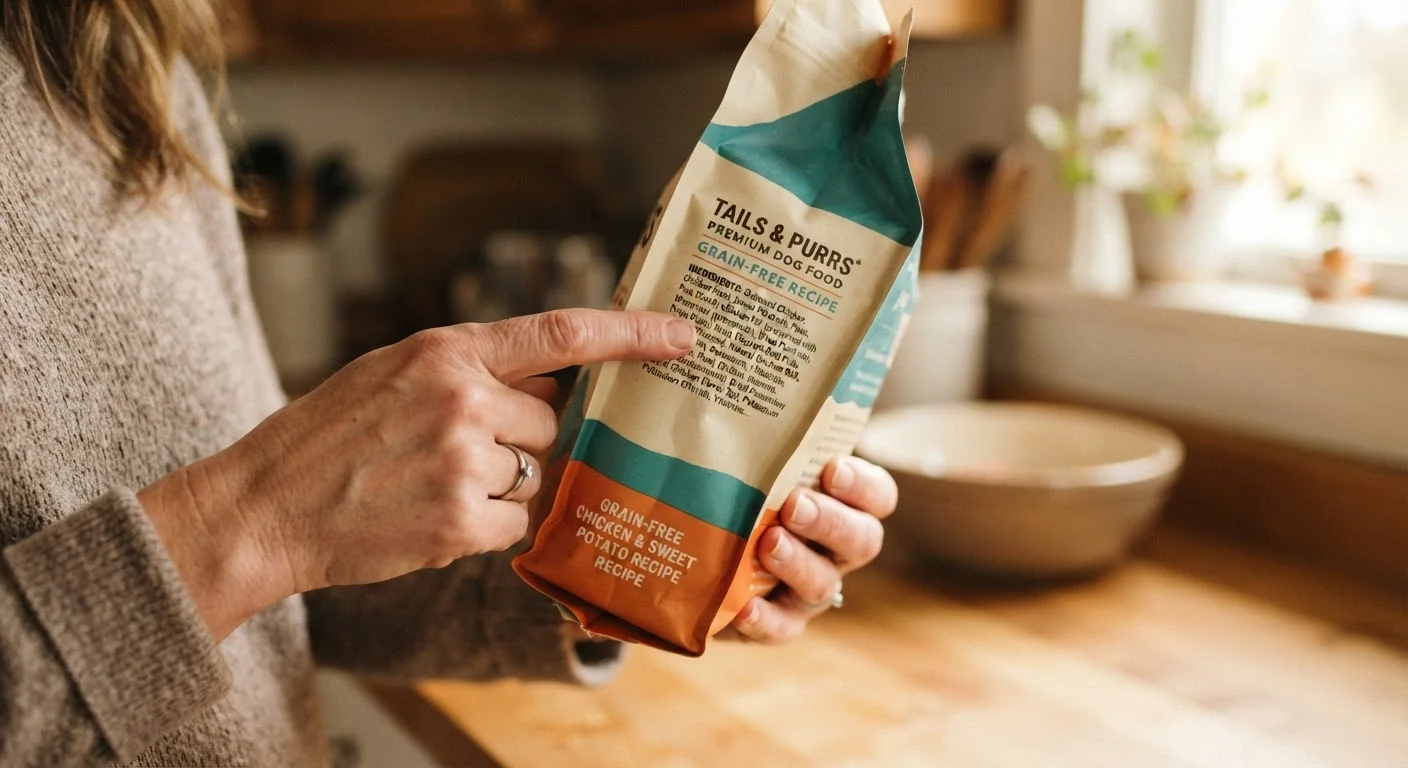
Photo credit: TopInfoTabs.com | Easy Insights For Inspiration
In this article
Ingredient lists, guaranteed analysis, feeding guidelines — here's what each section of a pet food label actually tells you.
Key Takeaways
- Ingredients are listed by pre-cooking weight, so context matters when interpreting their order.
- The guaranteed analysis shows minimum or maximum nutrient percentages, not exact amounts.
- AAFCO nutritional adequacy statements confirm whether a food meets established nutrient profiles.
- Feeding guidelines on labels are starting points - your pet's individual needs may differ.
- Marketing language like 'natural' or 'premium' has limited regulatory meaning on pet food labels.
Why Pet Food Labels Are Worth Understanding
Walk down any pet food aisle and you'll encounter a wall of claims: high-protein, grain-free, holistic, veterinarian-formulated. Most of that language appears on the front of the bag - and most of it is marketing. The real information is on the back or side panel, structured according to guidelines set by the Association of American Feed Control Officials (AAFCO) and enforced at the state level.
Learning to read that panel doesn't require a nutrition degree. It requires knowing what each section is actually measuring - and what it isn't. This guide walks through every label section in the order you're likely to encounter it. For a broader look at how nutrition labeling works across consumer products, see our nutrition label literacy guide.
What you will need
Decoding Each Section of the Label
Pet food labels follow a fairly consistent structure. Here's what to look for in each part.
Read the Product Name for Ingredient Clues
AAFCO rules govern how ingredient names appear in a product's title. If the label says 'Chicken Cat Food,' chicken must make up at least 95% of the total product (excluding water). A name like 'Chicken Dinner' or 'Chicken Entrée' only requires 25%. If chicken appears after the word 'with' - as in 'Cat Food with Chicken' - only 3% chicken is required. The word 'flavor' requires no specific minimum percentage at all.
This single rule explains why two bags with similar front-of-package imagery can contain dramatically different amounts of the featured ingredient.
Review the Ingredient List
Ingredients are listed in descending order by pre-cooking weight. This matters because whole meats contain significant water weight, which evaporates during processing. A food listing 'chicken' first may deliver less protein per dry ounce than a food listing a 'chicken meal' (which is already concentrated) slightly lower on the list.
Rather than fixating on whether a named meat is first, look at the first five to seven ingredients collectively - they represent the bulk of the food's composition. Also note whether any nutrient sources appear repeatedly under slightly different names (e.g., 'corn flour,' 'corn gluten meal,' 'ground corn'), a practice sometimes called ingredient splitting that can make a single component appear less dominant.
Understand the Guaranteed Analysis
The guaranteed analysis panel lists four core nutrients at minimum: crude protein (minimum), crude fat (minimum), crude fiber (maximum), and moisture (maximum). These are legal guarantees of extremes - not exact values. The actual protein content could be higher than the stated minimum.
Because wet and dry foods differ dramatically in moisture content, direct comparisons between the two formats require converting both to a dry matter basis. To do this: subtract the moisture percentage from 100, then divide the nutrient percentage by that result. For example, a wet food with 10% crude protein and 78% moisture - converted: 10 ÷ (100 − 78) = roughly 45% protein on a dry matter basis.
Locate the AAFCO Nutritional Adequacy Statement
This is arguably the most important line on the label. An AAFCO nutritional adequacy statement confirms whether the food is intended to be complete and balanced - and for which life stage. Statements typically read something like: 'formulated to meet the nutritional levels established by the AAFCO Dog Food Nutrient Profiles for maintenance' or 'for all life stages.'
There are two ways a food can earn this statement: by being formulated to match AAFCO nutrient profiles, or by passing AAFCO feeding trials. Both are legitimate, though feeding trials involve real animals consuming the food over time. If a label reads 'for supplemental or intermittent feeding only,' the food is not nutritionally complete on its own and should not be the sole diet.
Interpret the Feeding Guidelines
Feeding guidelines provide a starting range based on body weight, but they are estimates calibrated to an average, moderately active animal. Your pet's actual needs depend on age, activity level, reproductive status, metabolic rate, and health conditions.
Treat the label's recommended amount as a starting point. Monitor your pet's body condition - not just weight - over four to six weeks and adjust accordingly. Our body condition scoring guide offers practical tools for assessing whether your pet is receiving too little or too much.
Start With What Matters Most
If you only have time to check one thing on a new pet food, make it the AAFCO nutritional adequacy statement. A food that carries a complete and balanced claim for the appropriate life stage has at minimum cleared an established nutritional bar. Everything else on the label adds useful context, but that statement is the foundation.
Common Label Claims and What They Actually Mean
Even after you understand the regulated sections, you'll still encounter terms that sound meaningful but carry little legal weight.
- Natural: AAFCO defines this as ingredients derived from plant, animal, or mined sources without synthetic processing - but it doesn't imply nutritional superiority or safety.
- Premium / Ultra / Holistic: These are entirely unregulated marketing terms. No official standard distinguishes a 'holistic' food from any other.
- Human-grade: Only meaningful if the entire product - including its manufacturing facility - meets the legal definition of edible for humans. Verify this claim carefully rather than taking it at face value.
- Grain-free: Indicates the absence of grains, but not whether the food is nutritionally superior. Several widely held beliefs about grain-free diets don't hold up to scrutiny.
Marketing Claims Are Not Nutritional Guarantees
Terms like 'premium,' 'holistic,' and 'natural' are not defined or enforced by AAFCO or the FDA in ways that guarantee nutritional quality. A food bearing these labels is not automatically safer, more digestible, or better formulated than a food without them. Focus on the regulated sections - ingredient list, guaranteed analysis, and AAFCO statement - rather than front-of-package language.
If you're weighing wet versus dry formats as part of your label research, our wet food vs. dry food comparison covers the nutritional trade-offs in depth.
Putting It All Together
No single label section tells the whole story. An ingredient list might look impressive while the guaranteed analysis reveals low protein. A food might carry a legitimate AAFCO statement but have feeding guidelines that don't suit your pet's size or health status.
Use the label as a starting framework, not a final verdict. Your veterinarian can help interpret how a specific product fits your individual animal - particularly for pets with health conditions, weight concerns (see our guide to monitoring your pet's weight), or life-stage-specific requirements.
This article is for general informational purposes only and is not a substitute for professional veterinary nutritional advice. Always consult a licensed veterinarian for guidance specific to your pet's health and dietary needs.

Author
Pets & Animals Editorial Team
Pets & Animals Editorial Team is the collective byline for our editorial team and contributor network. Articles published under this byline or an editorial pen name are researched, written, and reviewed according to our editorial standards for clarity, consistency, and independence before publication.
View all articles →