
Fast Fashion vs. Slow Fashion: What the Labels Actually Mean for Your Wardrobe
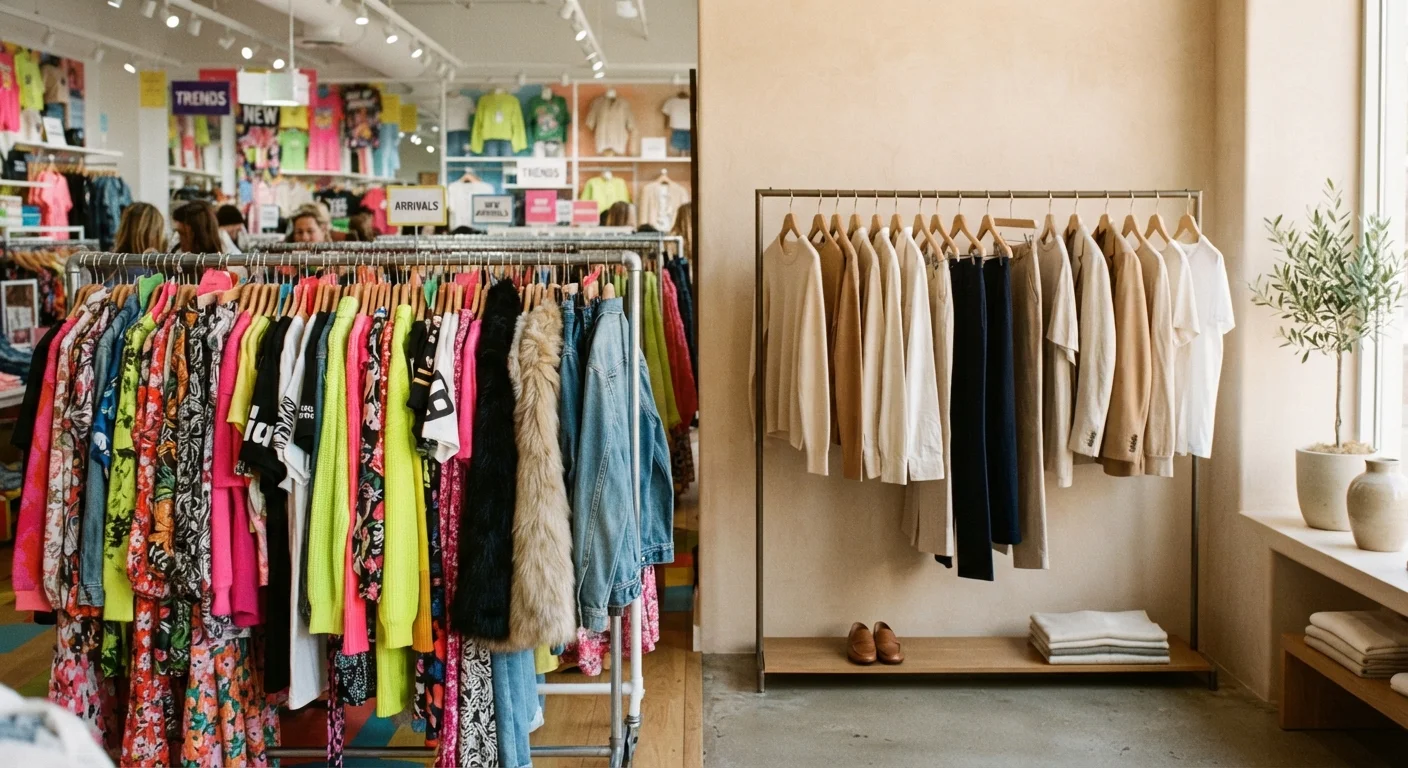
Photo credit: TopInfoTabs.com | Easy Insights For Inspiration
In this article
Beyond the buzzwords, what do fast and slow fashion really mean in practice? A clear breakdown to help you make more informed everyday wardrobe decisions.
Key Takeaways
- Fast fashion delivers trend-driven clothing quickly and at low price points, with shorter expected lifespans.
- Slow fashion emphasizes craftsmanship, longevity, and deliberate purchasing over volume.
- Neither model is all-or-nothing - most real wardrobes combine elements of both approaches.
- Cost-per-wear is a more useful measure than sticker price when evaluating clothing value.
- Understanding fabric and construction helps you identify quality regardless of which model a brand follows.
What These Terms Actually Describe
You've seen both terms scattered across think-pieces, social media threads, and brand marketing - but stripped of the rhetoric, fast fashion and slow fashion describe two distinct production and purchasing philosophies, not just good-versus-bad binaries.
Fast fashion is a retail model built on rapidly translating runway trends and cultural moments into affordable, widely available clothing - often within weeks. It prioritizes speed and volume. Pieces are priced accessibly, produced at scale, and designed around short trend cycles rather than enduring wearability.
Slow fashion is a counter-philosophy, not a specific certification or label. It describes clothing produced with greater attention to materials, construction, and supply chain conditions - intended to be worn repeatedly over a longer period. The emphasis is on buying less, choosing more carefully, and extending the usable life of each piece.
Neither term is legally defined, which matters: a brand can use "slow fashion" language in its marketing without meeting any standardized criteria. Understanding what sits behind the label - rather than the label itself - is where your real leverage as a consumer lies. Our guide on what quality actually means on a product label can help you decode the signals that indicate genuine construction value.
A Side-by-Side Look at the Key Differences
The practical differences between these two models show up in several concrete ways - from how quickly a new collection hits shelves to how a seam behaves after thirty washes. The table below maps the major contrasts.
| Criterion | Fast Fashion | Slow Fashion |
|---|---|---|
| Production speed | Weeks from trend to shelf | Longer lead times, smaller runs |
| Price point | Generally lower upfront | Generally higher upfront |
| Expected lifespan | Often 1-2 seasons | Multiple years with care |
| Material focus | Cost-optimized synthetics common | Natural or durable fabrics prioritized |
| Supply chain transparency | Typically limited | More often disclosed |
| Trend alignment | Closely follows current cycles | Favors enduring, classic styles |
| Purchasing philosophy | High volume, frequent refresh | Low volume, considered purchase |
It's worth noting that price and quality don't map perfectly onto either category. Some fast fashion pieces outperform expectations; some expensive slow fashion pieces disappoint. Fabric composition and construction quality - covered in detail in our plain-language guide to everyday clothing materials - are more reliable indicators than brand positioning alone.
The Cost-Per-Wear Question
One of the most useful mental shifts when thinking about either model is moving from sticker price to cost-per-wear: the price of a garment divided by how many times you realistically wear it.
A $15 top worn three times before it pills irreparably costs $5 per wear. A $90 blouse worn sixty times over three years costs $1.50 per wear. That's not a rule - it's a framework. And it only works if you're honest about what you'll actually reach for.
~10x
More clothing purchased per person since 1980s
The Ellen MacArthur Foundation has cited research suggesting clothing consumption has risen dramatically over recent decades, largely driven by falling prices and faster production cycles.
~$1.50
Illustrative cost-per-wear for a durable piece
A $90 garment worn 60 times over several years works out to roughly $1.50 per use - illustrating how upfront cost and long-term value can diverge significantly.
73%
Global clothing fiber that ends up in landfill or incinerated
The Ellen MacArthur Foundation estimates the large majority of clothing fiber globally is discarded rather than recycled or reused, highlighting the material scale of fast turnover models.
This is also where knowing your own wardrobe habits matters more than following either model's ideology. If you genuinely rotate through trend pieces and donate them in good condition, a fast fashion approach can be financially rational. If you find yourself drawn to the same five items every week, investing in their quality equivalents often makes more sense. For a deeper look at how price and value diverge, see our piece on value vs. price.
Slow fashion thinking also pairs naturally with a focus on signature pieces - the items that anchor your personal style across seasons. Explore that distinction in our article on signature pieces vs. trend pieces.
Building a Wardrobe That Works for Your Real Life
The most functional wardrobes most people actually maintain are neither purely fast nor purely slow - they're intentional hybrids. A wardrobe built around durable basics supplemented by occasional trend pieces, chosen with honest self-knowledge, tends to outperform any ideological extreme.
A few practical principles that hold regardless of which direction you lean:
- Fit shapes everything. A well-fitted garment from any price point will look and feel better than a poorly fitted one. See our breakdown of proportion and fit for the mechanics of why this matters.
- Know what occasions you're actually dressing for. Your real lifestyle - not an idealized one - should drive your wardrobe decisions. Our dress codes decoded guide is a useful reference for clarifying what different contexts actually require.
- Buy with the end in mind. Before purchasing, consider where the item goes when you're done with it - donation, resale, compost. Pieces with a second life built in extend value beyond your own use.
A Note on "Sustainable" Claims
Many brands use sustainability language - "eco," "conscious," "responsible" - without independent verification. In the US, the Federal Trade Commission's Green Guides provide a framework for evaluating environmental marketing claims, but certification standards vary widely. When a brand makes a specific environmental claim, looking for third-party certification or disclosed sourcing data gives you more reliable grounding than marketing copy alone.
For further personal style tips grounded in everyday wearability rather than trend pressure, our hub covers everything from building a capsule wardrobe to navigating secondhand shopping.

Author
Style & Beauty Editorial Team
Style & Beauty Editorial Team is the collective byline for our editorial team and contributor network. Articles published under this byline or an editorial pen name are researched, written, and reviewed according to our editorial standards for clarity, consistency, and independence before publication.
View all articles →