
Wired vs. Wireless Home Security Cameras: What Actually Matters
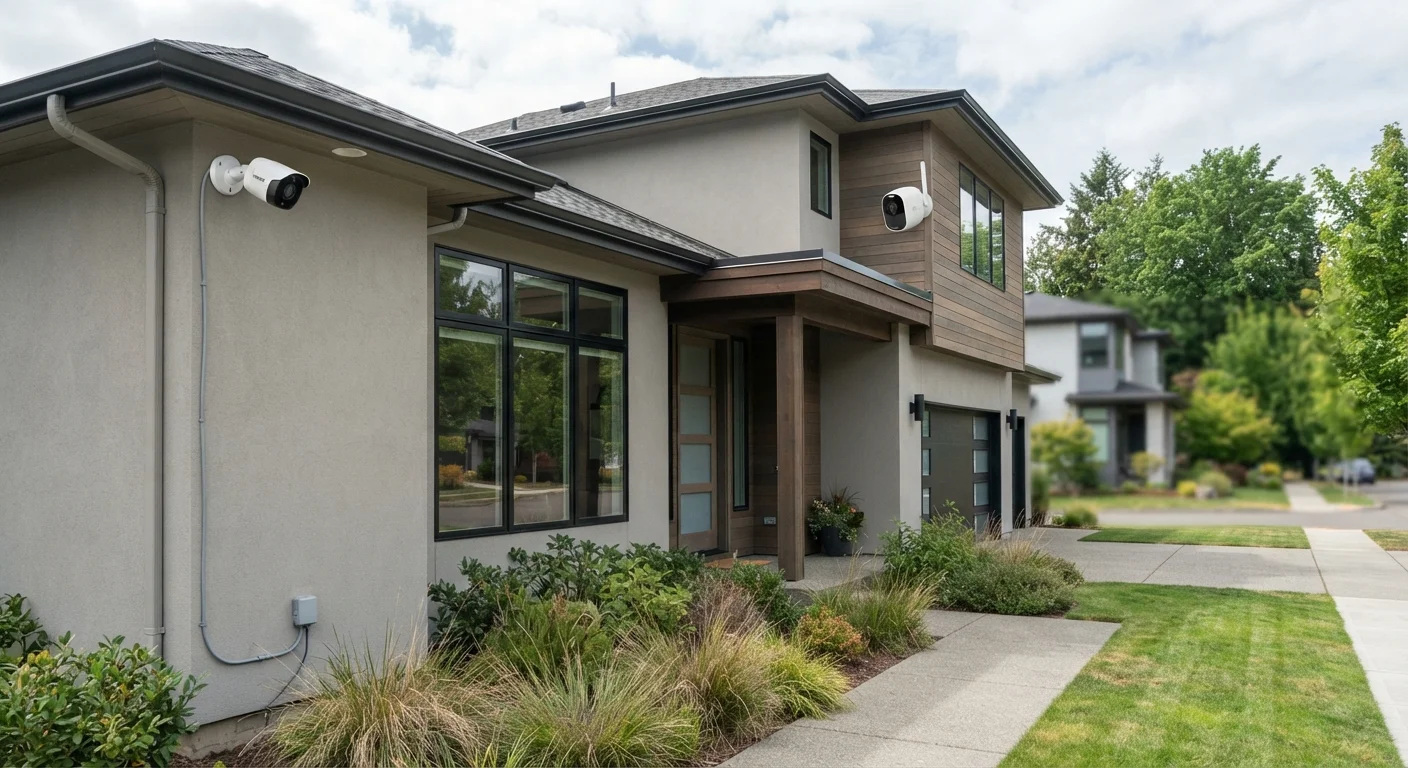
Photo credit: TopInfoTabs.com | Easy Insights For Inspiration
In this article
Wired and wireless home cameras each have real trade-offs. Here's how reliability, installation effort, and ongoing costs compare.
Key Takeaways
- Wired cameras deliver more consistent video quality and reliability, but require significant installation effort.
- Wireless cameras are faster to deploy and easier to reposition, but depend on battery life and Wi-Fi signal strength.
- Ongoing costs differ: wired systems may need professional setup upfront; wireless often involve cloud storage subscriptions.
- Neither type is universally superior - the right choice depends on your living situation, coverage goals, and technical comfort.
How Each System Actually Works
Wired security cameras transmit video and receive power through physical cables - typically coaxial cable for older analog systems, or Ethernet (often called PoE, or Power over Ethernet) for modern IP cameras. The footage routes to a local recorder: either a DVR (Digital Video Recorder) for analog systems or an NVR (Network Video Recorder) for IP-based setups. Because the connection is hardwired, the video stream doesn't compete with your home network's wireless bandwidth.
Wireless cameras connect to your home Wi-Fi network and are powered either by rechargeable batteries, solar panels, or a standard electrical outlet. Footage is typically uploaded to a cloud server or, in some cases, stored on a local SD card. A strong, stable Wi-Fi signal is essential - coverage gaps in your home translate directly into camera reliability issues. For more on how your network setup affects smart devices, see our guide to mesh Wi-Fi vs. traditional router setups.
| Criterion | Wired Cameras | Wireless Cameras |
|---|---|---|
| Power source | Hardwired (PoE or coaxial) | Battery, solar, or outlet |
| Installation effort | High - cables, drilling, often professional | Low - mount and connect to Wi-Fi |
| Reliability | Very high - no signal dependency | Moderate - depends on Wi-Fi stability |
| Video consistency | Stable, full resolution at all times | Variable with network conditions |
| Ongoing maintenance | Minimal once installed | Battery management required |
| Storage | Local NVR/DVR (low recurring cost) | Often cloud subscription required |
| Flexibility / portability | Fixed - not easily relocated | High - easily repositioned or moved |
| Suitability for renters | Generally not suitable | Well suited |
Installation, Maintenance, and Ongoing Costs
Installation complexity is where the gap between these systems is most pronounced. Running cables through walls, attics, or exterior soffits usually requires either significant DIY skill or a professional installer. For a multi-camera wired system, labor costs can add up quickly. That said, once installed, wired cameras demand very little ongoing maintenance - no batteries to swap, no firmware alerts about low charge.
Wireless cameras invert this equation. Setup is fast, but the maintenance cycle is ongoing. Battery-powered models typically need recharging every one to six months depending on activity level and climate. Cold weather, in particular, can shorten battery life noticeably. Additionally, many wireless camera platforms rely on paid cloud storage subscriptions to access recorded footage beyond the last 24 to 48 hours - a recurring cost that wired systems with local NVR storage largely avoid.
1-6 months
Typical battery life for wireless cameras
Battery duration varies widely based on camera activity frequency, temperature, and video resolution settings.
PoE
Standard wiring method for modern IP cameras
Power over Ethernet allows a single cable to carry both data and electrical power, simplifying multi-camera wired installations.
It's also worth factoring in the broader smart home context. If your cameras need to integrate with other devices or protocols, our explainer on smart home ecosystems and protocols covers what compatibility actually means in practice.
Video Quality, Reliability, and Security Considerations
Wired systems have a structural advantage in consistent video quality. Because they don't share bandwidth with the rest of your household's devices, they're less susceptible to buffering, dropped frames, or resolution throttling during peak network hours. High-definition wired cameras can reliably stream or record at full quality around the clock.
Wireless cameras have closed the quality gap considerably in recent years, and many record in 1080p or higher. However, performance depends heavily on signal strength at the camera's location. Walls, distance from the router, and interference from neighboring networks can all degrade the feed.
On the security side, both system types carry risks. Wired systems are harder to disable remotely but can be physically cut or tampered with. Wireless cameras, being internet-connected devices, carry network-level exposure - a misconfigured camera or weak account credentials can be a vulnerability. Our smart home privacy and network safety guide covers how to reduce that exposure through network segmentation and account hygiene.
Cloud Storage Costs Add Up Over Time
Many wireless camera platforms offer free storage for only 24-48 hours of footage. Extended history - often necessary for reviewing incidents that aren't discovered immediately - typically requires a monthly or annual subscription. Before committing to a wireless system, check the platform's storage tiers and factor that cost into your total ownership calculation alongside the hardware price.
For a broader view of what committing to smart home infrastructure actually involves day-to-day, our piece on the real trade-offs of running a smart home is worth reading before you invest in either system.

Author
Tech & Gadgets Editorial Team
Tech & Gadgets Editorial Team is the collective byline for our editorial team and contributor network. Articles published under this byline or an editorial pen name are researched, written, and reviewed according to our editorial standards for clarity, consistency, and independence before publication.
View all articles →