
Why Your Eyes Can Deceive You at Speed
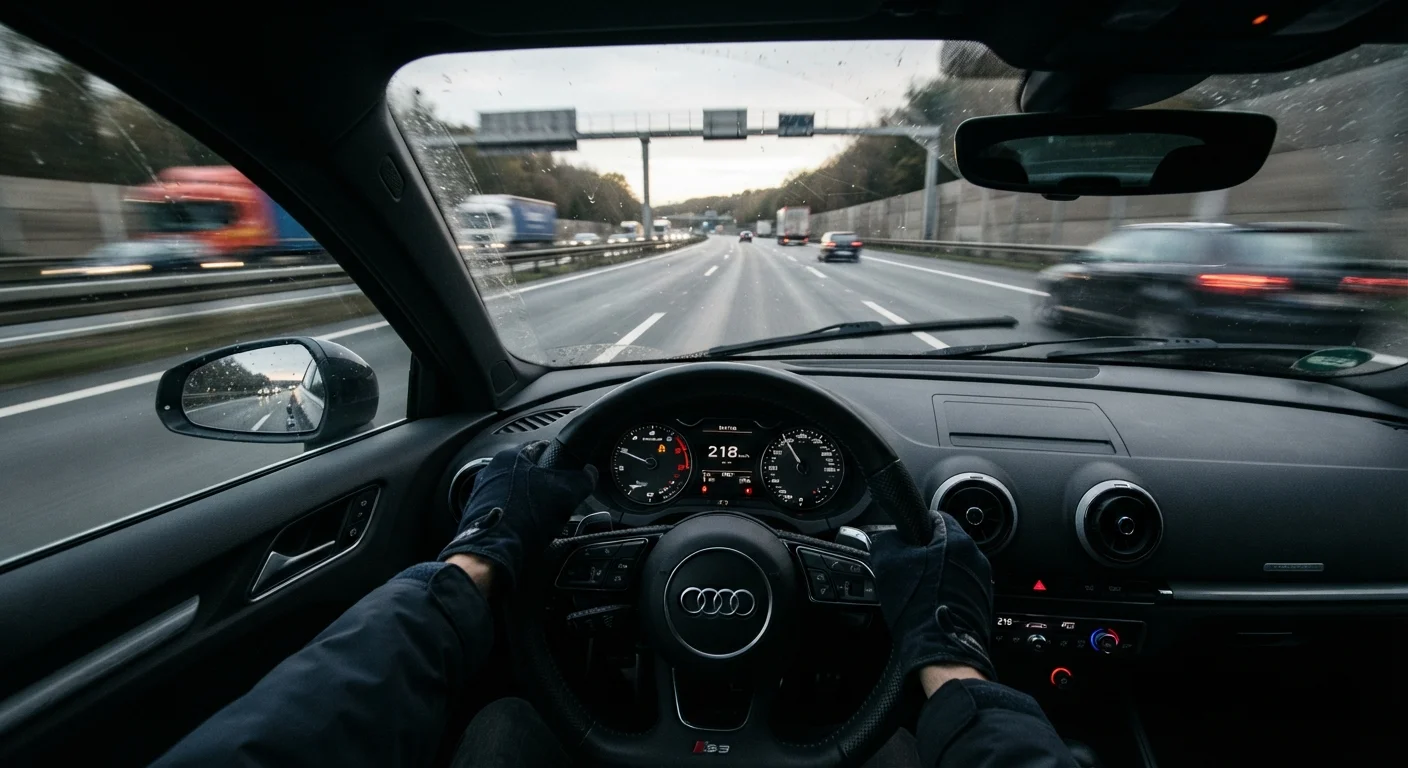
Photo credit: TopInfoTabs.com | Easy Insights For Inspiration
In this article
Speed narrows your field of vision and distorts distance judgement. Here's what happens to perception as you accelerate.
Key Takeaways
- Your usable field of vision can shrink dramatically as speed increases.
- The brain suppresses peripheral detail at high speed, creating false confidence.
- Distance and closing speed become harder to judge accurately above 60 mph.
- Reaction time stays constant, but the distance covered during that time grows with speed.
- Increasing following distance at higher speeds is one of the most effective compensations.
What Happens to Your Eyes When You Accelerate
At 30 mph, a driver can typically take in a wide scene - pedestrians on the pavement, a cyclist in the bike lane, movement at a junction ahead. By 70 mph, that same driver's attention is largely locked onto the road directly ahead. This isn't a choice; it's a physiological response.
The phenomenon is driven by optic flow - the visual sensation of the environment streaming past as you move forward. As optic flow intensifies with speed, the brain effectively narrows its processing window to manage the flood of incoming information. The result is reduced peripheral awareness, even though your eyes remain open and your vision is technically unimpaired.
Studies in driving psychology have consistently shown that the cone of useful vision - sometimes called the functional visual field - contracts significantly at high speeds. At highway speeds, hazards appearing from the sides are far more likely to be missed or noticed too late.
This Isn't a Visibility Problem
Speed-induced visual narrowing is distinct from poor eyesight or inadequate lighting. A driver with perfect 20/20 vision in daylight conditions is still subject to this effect. It's a processing and attention phenomenon, not an optical one - which is why corrective lenses or better headlights don't address it.
Why Distance Judgement Becomes Unreliable
Speed doesn't just affect what you see - it distorts how accurately you interpret what you see. Estimating the distance between your vehicle and another depends partly on detecting how quickly the gap between you is closing. At higher speeds, this rate of change accelerates rapidly, and the brain struggles to keep pace with it.
A common consequence is underestimating closing speed. A vehicle ahead that appears to be moving slowly may actually be travelling at 50 mph - and if you're doing 70 mph, the gap between you is closing at roughly 29 feet per second. This is part of why tailgating at motorway speeds carries such serious risk - drivers frequently misjudge how little time they actually have.
The relationship between speed and stopping distance compounds this further. Stopping distances increase non-linearly with speed - doubling your speed more than doubles the distance needed to stop - so a miscalculation in gap judgement has increasingly severe consequences the faster you travel.
~29 ft/sec
Gap-closing rate at a 20 mph speed differential
Basic kinematics: at 70 mph overtaking a 50 mph vehicle, the gap closes at approximately 29 feet every second, leaving very little margin for error.
4x
Increase in braking distance from 30 to 60 mph
Because braking distance increases with the square of speed, doubling your speed quadruples the braking distance required on a dry road surface.
~1.5 sec
Typical driver reaction time
At 70 mph, a 1.5-second reaction time translates to roughly 154 feet of distance covered before the brakes are even applied.
The Brain's Role: Confidence Without Accuracy
One of the most counterintuitive aspects of speed-related visual distortion is that drivers rarely feel impaired. The brain adapts to the narrowed visual field without broadcasting the change, which is why high-speed driving can feel routine even when perception is significantly compromised.
This mirrors some of the effects seen in driver fatigue, where degraded performance is often undetected by the driver themselves. In both cases, the person behind the wheel may feel entirely capable while their ability to perceive and respond to the road has meaningfully declined.
“The eye is not a camera - it's an interpreter. And at high speed, the brain increasingly edits what the eye delivers, prioritising the immediate path ahead at the expense of the broader scene.”
— Dr. David Shinar, Professor of Human Factors and Traffic Safety Research, Ben-Gurion University
The practical implication is straightforward: at speed, you need more time and space to compensate for what your visual system is not delivering. Scanning actively - moving your eyes deliberately to the sides rather than fixing your gaze - can partially offset the narrowing effect, but it requires conscious effort.
Adapting Your Driving to Visual Reality
Understanding this perceptual limitation leads directly to several practical habits. The most important is increasing following distance at higher speeds - not just to extend braking room, but to give your visual system time to detect and interpret developing hazards before they become emergencies.
Road environment matters too. Different road types demand different levels of visual attention. On a familiar dual carriageway, the brain can become complacent; on rural roads with tight bends or hidden junctions, the combination of speed and visual narrowing is particularly dangerous.
Visibility conditions also interact with these effects. Night driving adds reduced contrast and glare to an already-challenged visual system, making the case for lower speeds and greater margins even stronger.
Actively Scan, Don't Just Look Forward
Rather than letting your gaze rest at the centre of the lane, make a deliberate habit of moving your eyes across the full width of the road and checking mirrors regularly. At higher speeds, this conscious scanning partially compensates for the brain's tendency to narrow focus. It takes effort, but it meaningfully extends your awareness of developing hazards.
This article is intended for general road safety education and does not constitute professional driving instruction. Always follow the traffic laws applicable in your state and consult official guidance where needed.
Frequently Asked Questions

Author
Cars & Driving Editorial Team
Cars & Driving Editorial Team is the collective byline for our editorial team and contributor network. Articles published under this byline or an editorial pen name are researched, written, and reviewed according to our editorial standards for clarity, consistency, and independence before publication.
View all articles →